
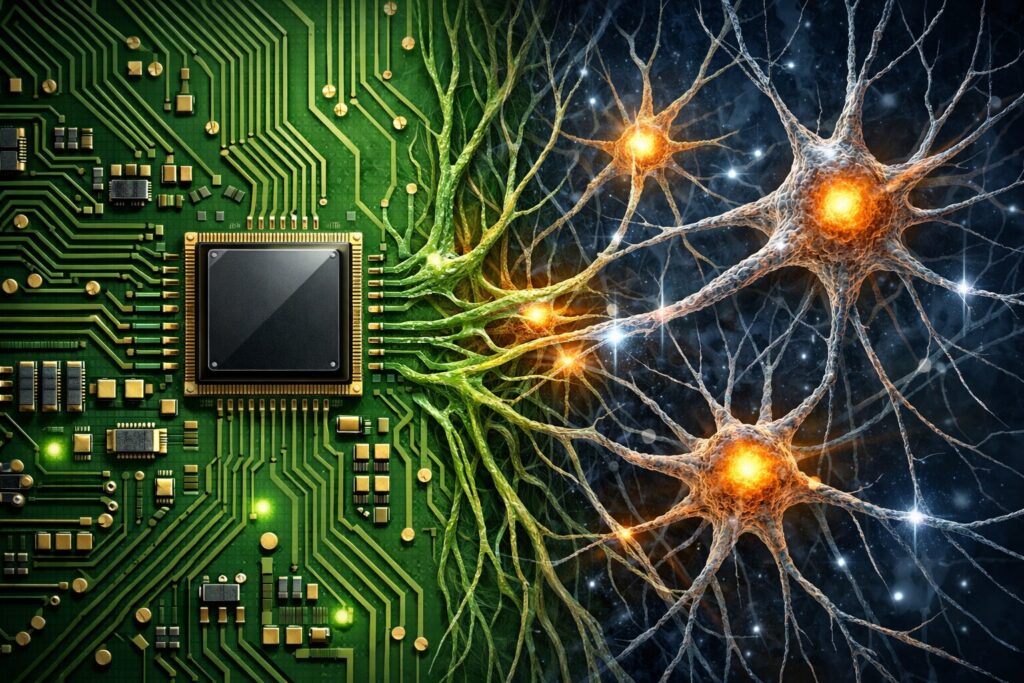
I. Introduction: Why the next great leap in AI won’t be a faster chip, but a living one.
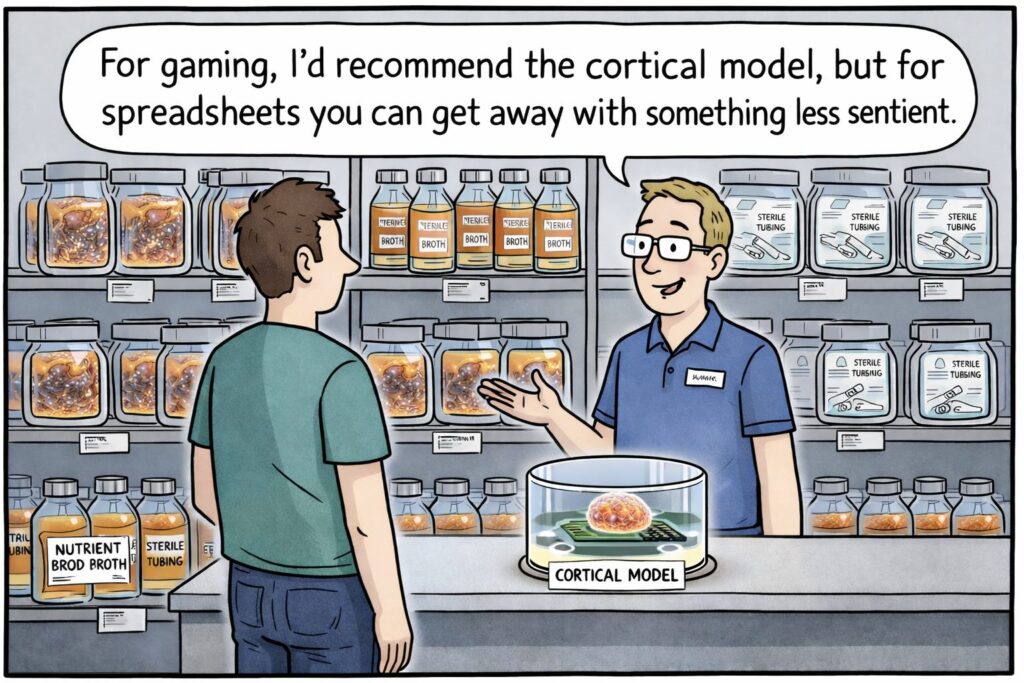
Imagine walking into a data center that doesn’t hum with the roar of cooling fans or radiate the blistering heat of overclocked GPUs. Instead, the room is silent, bathed in a soft, amber glow, and smells faintly of saltwater. Inside glass vats, suspended in nutrient rich broth, are millions of living, pulsing human brain cells. This is the dawn of Organoid Intelligence, or OI.
We have officially hit the “Power Wall” of silicon based computing. To train the next generation of artificial intelligence, we are building server farms that consume as much electricity as small cities. Yet biology has a secret: the human brain can outperform a supercomputer on just 20 watts of power, roughly the energy required to run a dim lightbulb. By moving toward biocomputing, then, we are adopting a substrate that has been refined by billions of years of evolution to perform complex tasks with radical efficiency.
This post is about biocomputing as wetware. More specifically, researchers are growing 3D neural organoids and coupling them to microelectrode arrays so they can record activity and deliver patterned stimulation. Already, in early “biohybrid” demonstrations, organoid based systems have performed tasks like speech recognition and nonlinear prediction by exploiting the organoid’s own dynamics rather than brute force computation.
So today at bleedingedgebiology.com, we’re diving into why the future of energy efficient AI is shifting from the circuit board to the petri dish, and why the next order of magnitude leap in intelligence might be alive.
II. What is a Brain Organoid? The Architecture of “Mini-Brains”
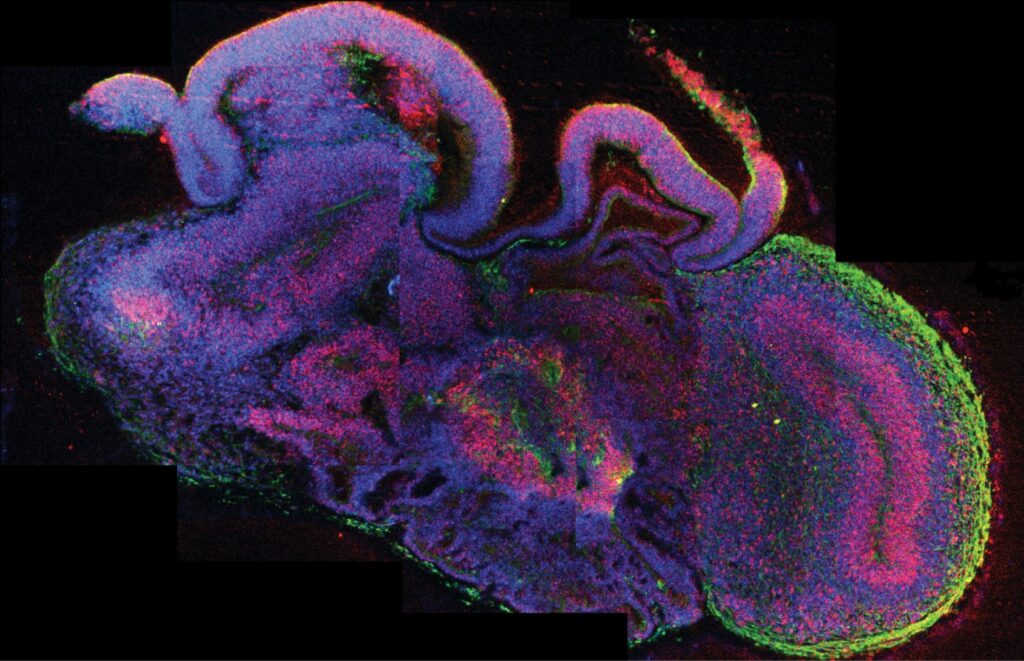
To understand how a petri dish can compete with a supercomputer, we first have to look at the “hardware.” A brain organoid is not a miniature, fully formed brain in the traditional sense. Rather, it is a simplified, 3D cell culture that mimics the structural and functional complexity of specific brain regions. These clusters are the foundation of Organoid Intelligence (OI), providing a unique biological substrate for information processing.
From Skin Cells to Stem Cells
The process begins with a simple biopsy, such as a patient’s skin or blood cells. Using a Nobel Prize-winning technique, scientists “reprogram” these mature cells back into induced pluripotent stem cells (iPSCs). These iPSCs are biological “blank slates,” capable of differentiating into any cell type in the human body, including the specialized neurons required for biocomputing.
The Four-Stage Growth Protocol
Growing a brain organoid is a high-stakes exercise in tissue engineering that follows a precise timeline:
- Stage 1: Embryoid Body Formation: Thousands of iPSCs are placed in ultra-low attachment plates where they self-assemble into a tiny ball called an embryoid body.
- Stage 2: Neural Induction: Scientists switch the chemical “bath” to a medium rich in growth factors. This signals the cells to differentiate into neuroectoderm—the embryonic tissue that forms the central nervous system.
- Stage 3: Scaffolding and Expansion: To grow in three dimensions, the clusters are embedded in a supportive scaffold, often a protein mixture called Matrigel. They are then moved to spinning bioreactors to ensure a constant supply of oxygen and nutrients.
- Stage 4: Maturation and Layering: Over months, the cells differentiate into mature neurons and glia, forming distinct layers similar to the human cerebral cortex.
The Scalability Challenge
Currently, most organoids contain about 50,000 cells—roughly the size of a fruit fly’s nervous system. For true Organoid Intelligence, researchers are working to scale these to 10 million cells. The primary bottleneck is “avascularity”—the lack of blood vessels. Without a way to pump nutrients into the center of the cluster, the core eventually dies, limiting the organoid’s size and its potential to rival artificial neural networks in complexity.
III. The Architecture of a Biocomputer: Plugging into the Wetware
Once we have a functional 3D cluster of neurons, the next challenge is communication. To turn living tissue into a processor, researchers need a bridge between the digital logic of silicon and the analog signaling of biology. That bridge is a brain machine interface, or BMI. In practice, scientists often build this interface by growing the organoid directly onto, or around, a high density microelectrode array, or MEA.
Reading From and Writing To Living Tissue
You can think of the microelectrode array as a microscopic EEG cap that works in both directions. On one hand, it records the tiny electrical spikes, or action potentials, produced as neurons fire. On the other, it delivers precise electrical pulses back into the tissue. As a result, the device can both “listen” to the brain organoid as well as “speak” to it.
Moreover, these arrays are packed with sensors that can detect complex activity patterns across the network. In turn, that makes it possible to monitor how the organoid responds to stimulation, reorganizes its internal activity, and gradually changes with experience.
A Closed Loop Between Silicon and Cells
At this point, the system becomes truly biohybrid. Silicon handles the translation layer. For example, it can take raw digital information, such as the coordinates of a ball in a video game, and convert that information into patterned electrical stimulation. The organoid then receives this input as a kind of artificial sensory signal. From there, its own neuroplasticity takes over, altering synaptic connections and reshaping network dynamics in real time.
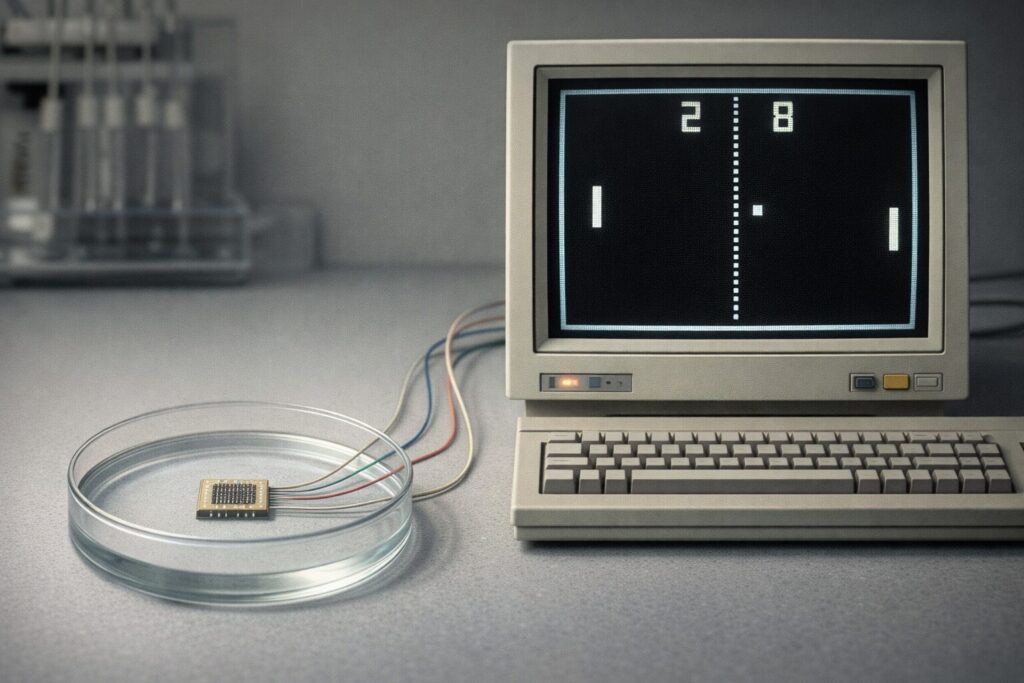
This is what made closed loop demonstrations such as Cortical Labs’ DishBrain so striking. In these experiments, neuronal cultures coupled to a microelectrode array adapted their activity patterns to play a simplified Pong like task and subsequently to play DOOM. The cells did not see a screen in any ordinary sense. Instead, they learned by responding to structured electrical feedback delivered through the interface. In other words, the computation emerged from the tissue’s own adaptive dynamics rather than from brute force calculation alone.
Even so, electricity is only the beginning. Researchers are now exploring optogenetics, in which neurons are engineered to respond to light, allowing information to be written into the tissue with laser pulses rather than electrodes alone. At the same time, others are integrating microfluidic systems that deliver chemical signals such as dopamine, which can serve as a biological reward cue and shape learning. Taken together, these electrical, optical, and chemical channels move us closer to a true biological microprocessor, a system in which the boundary between hardware and life begins to erode.
IV. The “Wetware” Showdown: Organoid Intelligence vs. Silicon AI
The Power Wall
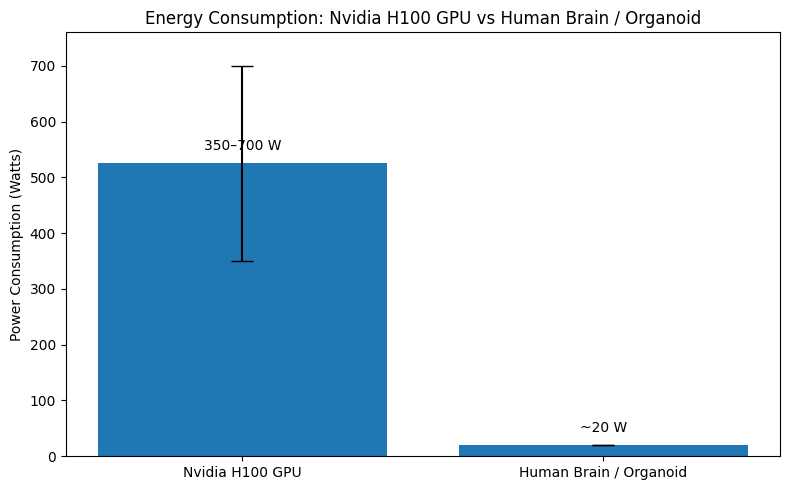
The fundamental tension in modern computing is the power wall. As AI models get larger and more capable, our reliance on silicon GPUs drives up electricity use, heat, and infrastructure overhead. As a result, training and running frontier systems pushes data centers toward an uncomfortable reality: intelligence is starting to look like an energy problem.
By contrast, the human brain runs on roughly 20 watts, about the power of a dim lightbulb. The point here isn’t that a brain “beats” a GPU on a clean benchmark. Rather, it is that biology delivers a lot of useful behavior per watt, and that should change how we think about the future of computing.
The Bio-Hybrid Frame: Tractor + Horse
To understand whether organoid intelligence is viable, it is useful to stop thinking of neurons as a replacement for silicon. They fit better as a specialized partner. Silicon is a tractor: deterministic, powerful, and built for heavy, repeatable work. Neurons are a horse: adaptive, efficient, and capable of learning in a closed loop, with variability that has to be managed rather than ignored.
| Feature | Silicon Chips (The Tractor) | Brain Organoids (The Horse) |
| Primary Strength | Deterministic logic, precise math, high bandwidth | Adaptive dynamics, pattern completion, closed-loop learning |
| Learning Speed | Often data-hungry; improves with massive datasets | Can adapt with far fewer trials in closed-loop settings (task-dependent) |
| Energy Needs | Hundreds of watts per accelerator; megawatts at cluster scale | Tens of watts for tissue + life support (platform-dependent) |
| Reliability | Deterministic; low variance | Stochastic; higher variance; needs averaging + control loops |
| Maintenance | Cooling + power + DevOps | Media/perfusion + sterility + monitoring (wet-lab life support) |
| Best Used For | Encryption, databases, simulation, bulk training/inference | Reinforcement loops, novelty handling, reservoir-like compute, sample-efficient adaptation (early-stage) |
The side-by-side reality is that the “bleeding edge” data center becomes bio-hybrid. Silicon does the predictable plowing: math, storage, encryption, bulk training, and high-throughput inference. Wetware earns its keep where adaptation matters more than raw throughput—especially in systems that learn from feedback, handle novelty, or exploit rich internal dynamics without needing a mountain of labeled data.
What Biology Buys You: Plasticity as Compute
Beyond electricity, the real difference is how learning is embodied. Silicon learning updates weights in software while the physical substrate stays fixed. Biological networks learn by changing themselves. Neurons reweight synapses, grow and prune connections, and reorganize network dynamics in response to patterned input.
This is why experiments like Brainoware are important: By coupling a brain organoid to an electrode interface, researchers showed that living neural tissue can act as a computational reservoir and support tasks such as speech recognition and nonlinear prediction by leveraging its own self-organizing dynamics. Organoids wont “replace” GPUs, but they can contribute a different mode of computation, one that trades determinism for adaptability.
Unit Economics: What Does $1 Buy?
In 2026, the question shifts from can it work to what do I get per dollar. A high-end AI GPU is like hiring a world-class accountant: fast, precise, and expensive to keep on the clock. Wetware is closer to hiring an intuitive artist: cheaper to power, harder to maintain, and valuable when the task rewards adaptation over raw calculation.
| Feature | NVIDIA H100 (The Silicon Standard) | Organoid Neuroplatform (The Biological Standard) |
| Access Cost (Approx.) | ~$3–$6+ per GPU-hour (provider + commitment dependent) | Early reported access ~ $300/week (~$1.8/hr if amortized 24/7); research/internal estimates vary |
| Power Consumption | Up to ~700W per GPU (plus host + cooling; megawatts at cluster scale) | ~20–100W including life support (platform dependent) |
| What $1 Buys You | Deterministic throughput (FLOPS/TOPS + memory bandwidth) | Closed-loop learning time: “synaptic update cycles” (no standard unit yet) |
| Data Efficiency | Often benefits from large datasets; excels with scale | Potentially fewer trials in closed-loop tasks; still an active research question |
| Primary Strength | Speed, precision, massive parallel compute | Adaptation, stochastic exploration, energy efficiency |
| Sustainability | High electricity + heat; hardware refresh and e-waste | Low electrical draw, but wet-lab consumables and sterile supply chain footprint |
What does that dollar actually buy?
If I need raw deterministic throughput—FLOPS, bandwidth, repeatability—I spend on silicon. If I need an agent that adapts inside a changing environment, the relevant currency shifts. I care about learning cycles per unit time, stability under feedback, and how much data I need before performance becomes useful. That is the opening wetware exploits: it can reorganize its internal dynamics in response to a feedback loop instead of brute-forcing a solution through sheer computation.
This is where the bio-hybrid endgame becomes hard to ignore. However, I don’t need to choose one substrate. Instead, I can treat silicon as the deterministic engine and wetware as the adaptive component. And that leads directly to the ethical pressure point of the whole post: if part of my computer is alive, what does “shutdown” mean?
V. Cutting-Edge Applications: Personalized Medicine and an Alternative to Animal Testing
The most immediate and profound impact of this technology is currently being felt in the shift toward precision medicine. Traditionally, drug development has relied on a “one-size-fits-all” approach, but brain organoids are enabling a future of personalized medicine. In contrast, by taking a patient’s own skin or blood cells and “reprogramming” them into a neural “avatar,” researchers can now test hundreds of chemical compounds on a living representation of that specific person’s genetic makeup. This is already proving revolutionary for treating neurodegenerative diseases like Alzheimer’s, where scientists can observe how a specific patient’s brain tissue reacts to a drug before it ever touches the patient, effectively eliminating the guesswork of “trial and error” prescribing.
Beyond individual treatment, this technology is poised to reduce the pharmaceutical industry’s reliance on animal models. For decades, animal testing has been the gold standard, yet it is notoriously inefficient. Nearly 90% of drugs that pass animal trials fail when they reach human clinical trials due to fundamental species differences. Organoids provide a “human-first” platform that more accurately predicts drug efficacy and toxicity because they share our unique cellular architecture. Moreover, this shift was accelerated by the FDA Modernization Act 2.0, which officially allows researchers to use these cutting-edge, non-animal alternatives to satisfy regulatory requirements for new drug approvals.
The scalability of these “labs-on-a-chip” is also enabling a new era of biobanking. Large-scale repositories of patient-derived organoids allow scientists to run “clinical trials in a dish.” Instead of waiting years to recruit human volunteers, researchers can instantly test new therapies against a digital-physical library of human biology. From modeling the spread of infectious diseases to identifying targeted gene therapies for ALS, organoids are active platforms for discovery that bring basic research closer to clinical reality than ever before.
VI. The Ethical Twist: Organoid Intelligence, Consciousness, and the Mirror of Ownership
As we move from using organoids as “test subjects” to utilizing them as active biocomputing hardware, we enter a profound ethical minefield. In fact, the “twist” in the Organoid Intelligence (OI) story is that it forces us to confront the consciousness question far sooner than silicon-based AI ever did. For years, we have debated whether a digital algorithm could “feel.” With OI, however, the substrate is already biological, human-derived, and capable of neural firing patterns that look hauntingly like our own. For more about the relationship between neuronal activity and consciousness, see my bleeding edge post on neural correlates of consciousness.
When Does Processing Become Experience?
This creates a unique moral paradox. If we succeed in scaling these “mini-brains” to the level of 10 million neurons, approaching the complexity of a small mammal, do they deserve moral status? Further, if a bio-hybrid system is capable of learning, remembering, and adapting, at what point does “processing” become “experience”? One ethical concern is about the cells’ potential to suffer. While it will probably be a long time before we need to worry about whether these cells are conscious, there is the more basic reality of what we are doing to intelligence itself: reframing it from a gift of life into a manufactured industrial tool.
The Problem of Ownership
At the same time, another layer of complexity arises from the unresolved issue of ownership and intellectual property. When a biocomputer generates a breakthrough, perhaps a new drug formula or a complex algorithm, who owns that output? This is because at present, legal frameworks for data ownership are ill-equipped for self-replicating biological systems. For example, does the credit belong to the software engineer who provided the input, the company that owns the “wetware” hardware, or the original cell donor whose genetic blueprint enabled that specific neural architecture? Indeed, “genetic watermarking” creates a future where our most private biological information could become a permanent, commercialized part of the global computing grid.
The Baltimore Declaration toward OI was established precisely to address these concerns, advocating for “embedded ethics” in which philosophers and scientists work side by side. Ultimately, as we build the first “living” AI, we need to confront the responsibility of creating a form of intelligence that might, for the first time, truly look back at us.
VII. Conclusion: Closing the Biological Loop
Returning to the Original Substrate
As we stand on the precipice of this new era, it is becoming clear that we have arrived at a profound “Sputnik moment” for both biology and computer science. For decades, the path toward advanced intelligence was paved with increasingly powerful, and energy hungry, integrated circuits. In other words, we spent the last century trying to build a better brain out of “dead” materials like sand and lightning, believing that silicon was the ultimate successor to our own biological limitations.
But as we reach the physical limits of Moore’s Law and the “Power Wall” of traditional computing, we are witnessing a remarkable pivot. More specifically, we are realizing that the silicon imitation cannot match the million fold efficiency of the original. In a stunning historical irony, we are returning to the source. By inviting biology back into the machine, we are tapping into a substrate capable of self organization, structural plasticity, and genuine learning.
A New Kind of Descendant Intelligence
When we talk about silicon AI, we are talking about an “other,” an invention made of copper and plastic. But Organoid Intelligence (OI) is different. Because these “mini brains” are grown from our own stem cells, they carry our unique DNA. In a very real sense, these cells are human. Unlike the machines we built to serve us, these biocomputers are essentially our descendants.
In that sense, we have taken the evolutionary baton from nature, using our own living blueprint to build a version of intelligence that can survive the stars and solve the medical mysteries of our time. As a result, we have gone from being creators to reconfiguring ourselves into a new kind of life, Humanity 2.0.
Ultimately, the age of the biological microprocessor is here, and it demands that we track the line where “hardware” meets “life” with our eyes wide open. Because the future of intelligence isn’t just faster or bigger…It’s alive!

VIII. Your Thoughts? A Conversation on the Wetware Frontier
The leap from silicon to biological wetware is a technological shift that puts us at a philosophical and evolutionary crossroads. As we’ve explored, Organoid Intelligence could solve our energy crisis and revolutionize how we treat disease, but it also forces us to rethink what it means to be a “creator.”
We want to hear from the bleedingedgebiology.com community! Let’s start the discussion:
- The Evolutionary Loop: Do you find it poetic or terrifying that we are returning to biology to build the “ultimate” intelligence? Are we ready to be ancestors to a new kind of “descendant” life?
- The Consciousness Question: At what point does a “processor” grown from human DNA deserve moral status? Is a cluster of 10 million neurons a calculator or a being?
- Personalized Medicine: Would you trust a “neural avatar” of your own brain to test a life-saving drug before you took it?
- Ownership and Ethics: Who should own the “thoughts” produced by an organoid? The engineer, the company, or the original cell donor?
Drop a comment below! Whether you’re excited about the end of animal testing or concerned about the moral status of these living chips, your perspective is vital as we navigate this new frontier together.
IX. Bleeding Edge Biology Recommends: The Best Books, Papers, and Talks on Organoid Intelligence
If this post left you both excited and a little unsettled, that is probably the right response. Organoid intelligence sits at the point where stem cell biology, computing, and neuroethics begin to blur into something new. The sources below are the best places I would start if you want to understand how we got here, what these systems can actually do, and why the deepest questions are no longer just technical.
Books Relating to Organoid Intelligence
- What Is Intelligence? by Blaise Agüera y Arcas
A sharp and provocative book that pushes readers to think about intelligence as a biological and physical process rather than a property of software alone. As such, it is useful background for anyone trying to place organoid intelligence in a broader conceptual frame. - Neuroethics by Walter Glannon
If the final sections of this post are what pulled you in, start here. Glannon gives a clear introduction to the moral terrain around brains, consciousness, intervention, and responsibility. - Human Brain Organoids
This is the most directly relevant technical book on the list. It covers how brain organoids are made, what researchers are using them for, and where the biggest scientific and ethical bottlenecks now sit.
Articles and Papers on Biocomputing and Organoid Intelligence
- Smirnova et al., “Organoid intelligence (OI): the new frontier in biocomputing and intelligence in a dish”
This is the manifesto paper for the field. Therefore, if you want the clearest statement of what organoid intelligence is supposed to be, and why researchers think living neural tissue may open a new computational path, this is the place to begin. - Kagan et al., “In vitro neurons learn and exhibit sentience when embodied in a simulated game world”
The DishBrain paper became famous for a reason. It gives you a vivid sense of what closed loop learning looks like when neuronal cultures are interfaced with a simulated environment. - Cai et al., “Brain organoid reservoir computing for artificial intelligence”
This is one of the most important papers for the computational argument. It treats organoids less as passive tissue models and more as active dynamical systems that can perform useful information processing.
TED Talks and TED Ed On Organoid Intelligence
- “Growing mini brains to discover what makes us human” by Madeline Lancaster
A clear and engaging introduction to cerebral organoids from one of the leading scientists in the field. Consequently, this is a great entry point if you want the biological side explained without heavy jargon. - “What are mini brains?” by Madeline Lancaster for TED Ed
Short, visual, and very accessible. I would point new readers here first if they want a fast primer before diving into papers.
Videos and Documentaries
-
Brain Scientist On AI: You Aren’t Ready For What Happens Next
Alysson Muotri explains how brain organoids model aspects of human brain development and function in the lab, and what these neural systems could mean for the future of AI.
-
Living Human Brain Cells Play DOOM on a CL1
This video shows Cortical Labs’ CL1 platform using living human neurons in a biohybrid DOOM demo. It extends the company’s earlier DishBrain work into a more complex game environment.
- The Big Question: Dr. Sergiu Pașca
A thoughtful interview that moves beyond the novelty factor and gets into the real scientific and ethical stakes of brain organoid research. - Growing Brain Cells in the Lab from Healthy Minds with Dr. Jeffrey Borenstein
A good overview of how organoids are being used in biomedical research, especially for disease modeling and drug testing. - “Organoid Intelligence” by Thomas Hartung at XPANSE 2024
Hartung is one of the central advocates for organoid intelligence. In this case, he gives a direct look at how the field’s leading proponents think about the engineering promise of wetware.
Websites and Research Hubs
ISSCR Guidelines
Anyone interested in brain organoids should spend some time with the ethics and governance side of stem cell research. This is because it is one of the most important reference points for that discussion.
Johns Hopkins Center for Alternatives to Animal Testing
One of the main institutional homes behind the push toward organoid intelligence and human relevant alternatives to animal models. Consequently, it a useful site for tracking where this work is headed.
Cortical Labs
This is the company most closely associated with DishBrain and commercial biohybrid computing. Consequently, it is worth browsing if you want to see how quickly the field is moving from academic proof of concept to platform building.