

Every drug you have ever swallowed was dead before it reached you.
A pill dissolves. A molecule drifts through your bloodstream. It reaches its target…or it doesn’t. After a few hours, it’s gone. Then you take another one. That is how medicine has worked for most of human history. You put a chemical in. A fixed thing happens. Eventually, it ends. The chemistry can be sophisticated, but the underlying logic is blunt.
Now, however, a fundamentally different kind of medicine is being built. I find it one of the most exciting developments in modern biology. These therapies are alive. They are living therapeutics, bacteria engineered with synthetic gene circuits that read the chemistry of your body in real time. When they detect inflammation, they produce an anti-inflammatory molecule. When they sense the oxygen-starved environment of a tumor, they multiply and release a bacteria cancer treatment payload. Upon reaching a wound in the gut lining, they glue themselves to the damaged tissue and release a healing protein. In short, these systems decide when and where treatment is delivered.
Moreover, this is no longer purely theoretical. Engineered bacteria treatment has already reached human clinical trials. Researchers have demonstrated tumor shrinkage in animal models. In parallel, scientists have proven that synthetic gene circuits can detect disease signals inside the body with extraordinary sensitivity. The field is young and the regulatory path is still developing. Even so, the core idea is established: synthetic biology medicine lets us program a microbe like software and send it inside a patient to do a job.
Living therapeutics are bacteria engineered with synthetic gene circuits that read the chemistry of your body in real time and decide when and where to act.
What Makes a Bacterium a Living Therapeutic?
To understand living therapeutics, it helps to understand what they replace. Conventional drugs flood the body with a molecule. The liver degrades it. Meanwhile, the kidneys excrete it, and tissue barriers block it. Side effects appear far from the target. No traditional bacteria drug delivery system existed before this field emerged, because no one had a way to program bacteria to deliver anything at all.
Bacteria, by contrast, already live inside us. Your gut contains trillions of them. Crucially, they navigate complex chemical environments, respond to signals, and perform biological functions with remarkable precision. The key insight behind living therapeutics is straightforward: these capabilities can be redirected. Rather than relying on a bacterium’s natural programming, synthetic biology medicine lets researchers write entirely new instructions. To that end, they install synthetic gene circuits that act like biological software: if this signal is detected, execute this response.
The bacterial host used for most engineered bacteria treatment is typically a safe, well-studied strain. The most widely used is Escherichia coli Nissle 1917. This E. coli Nissle therapeutic strain is a probiotic that humans have consumed safely for over a century. It is easy to engineer, has a well-mapped genome, and naturally colonizes the gut. Additionally, researchers use Lactococcus lactis and various Lactobacillus species as engineered probiotics for gut applications. For cancer work, they turn to strains of Salmonella and Clostridium that naturally seek out tumors.

The engineering tools come from synthetic biology medicine: CRISPR-based genome editing, modular synthetic gene circuits built from well-characterized parts, and precisely designed promoters that activate gene expression only under specific conditions. The result is a bacterium that carries new therapeutic instructions alongside its normal biology. A living machine with a medical purpose written into its DNA.
Living Therapeutics for Gut Disease: Engineered Probiotics in Action
The gastrointestinal tract is where the living therapeutics field has made its most significant clinical progress. Several reasons explain this. First, the gut is accessible by mouth, the simplest delivery route in medicine. Second, it already houses a vast microbial community, so introducing engineered probiotics is not foreign to the environment. Third, and most importantly, inflammatory bowel disease represents exactly the kind of problem that live biotherapeutic products are designed to solve.
IBD affects more than six million people worldwide. Standard treatments use biologics like adalimumab to suppress inflammation throughout the entire body. The problem, however, is that the inflammation is local. Specifically, the disease lives in the gut. Nevertheless, the drug circulates everywhere to reach it. This systemic approach creates real immune consequences. It is precisely this inefficiency that engineered probiotics and live biotherapeutic products are designed to eliminate.
Researchers have built E. coli Nissle strains equipped with synthetic gene circuits that detect specific inflammation biomarkers: nitric oxide, reactive oxygen species, and tetrathionate. These molecules appear in the gut precisely where and when inflammation occurs. Once the engineered probiotics detect these signals, they switch on anti-inflammatory production. As a result, therapy reaches the inflamed tissue directly. Healthy tissue receives nothing. Put simply, this is bacteria drug delivery at its most targeted.
A 2024 study pushed this engineered bacteria treatment further still. Researchers engineered E. coli with a blood-sensing synthetic gene circuit. This circuit detected gastrointestinal bleeding at concentrations as low as 100 parts per million. Once it detected blood, the bacteria activated two responses simultaneously. First, they produced an adhesive protein derived from barnacle cement. Second, they released a healing peptide called TFF3, which is essential for mucosal repair. Consequently, the living therapeutics stuck themselves to the wound, sealed it, and began repairing the tissue from the inside. In mouse models, the system reduced bleeding, alleviated inflammation, and enhanced intestinal barrier repair. No conventional drug can do all of that in one step.

Furthermore, another approach used an E. coli Nissle therapeutic strain engineered with a nitric oxide sensor. Nitric oxide is a key indicator of intestinal inflammation. The bacteria paired this sensor with a secretion system that releases humanized anti-TNFα nanobodies on demand. TNFα is the same target as adalimumab, the blockbuster biologic known as Humira. Notably, the engineered bacteria produced nanobodies with binding affinities comparable to Humira but delivered them locally, only where the inflammation signal was present. When I first read this result, it struck me as a genuine inflection point. Same target, same efficacy, but the living therapeutic acts only where it is needed.
The living therapeutics stuck themselves to the wound, sealed it, and began repairing the tissue from the inside, a capability no conventional drug can replicate.
Bacteria Cancer Treatment: Living Therapeutics That Navigate Tumors
Cancer presents a harder problem, but also a more dramatic opportunity for living therapeutics. Solid tumors create a distinctive microenvironment: low oxygen, low pH, high lactate, and immune suppression. These conditions are hostile to normal tissue and to most drugs. Yet paradoxically, certain bacteria find them attractive. Over millions of years, those organisms evolved to exploit exactly these anaerobic, nutrient-rich niches. That biological quirk makes bacteria cancer treatment not just plausible but scientifically logical.
This idea has deep historical roots. In the late nineteenth century, surgeon William Coley noticed that some cancer patients who developed bacterial infections experienced unexpected tumor regression. As a result, he began deliberately injecting bacteria into tumors and reported remissions that puzzled his colleagues. Eventually, the approach was abandoned as chemotherapy and radiation emerged. However, Coley’s core observation proved correct: bacteria can home to tumors and trigger immune responses that fight cancer. Today, synthetic biology medicine has revived that insight with precision he never had.

Clostridium: A Living Therapeutic That Hunts Tumors
Clostridium sporogenes is an anaerobic bacterium, meaning it cannot survive in the presence of oxygen. This makes it a natural candidate for bacteria cancer treatment. Tumors contain large hypoxic cores where oxygen levels are nearly zero. Clostridium colonizes these regions while dying off in healthy, oxygenated tissue. In other words, the selectivity is built directly into the organism’s biology. No engineered drug molecule has matched this kind of passive tumor targeting.
Researchers at the University of Waterloo have developed C. sporogenes as a living therapeutic for solid tumors. Their work tackled two core challenges in engineered bacteria treatment. First, the bacterium’s oxygen sensitivity means it colonizes tumor cores but dies at the margins. To solve this, the team introduced a gene from a more oxygen-tolerant relative. As a result, the live biotherapeutic product can now survive in at least some oxygen and penetrate further into the tumor periphery.
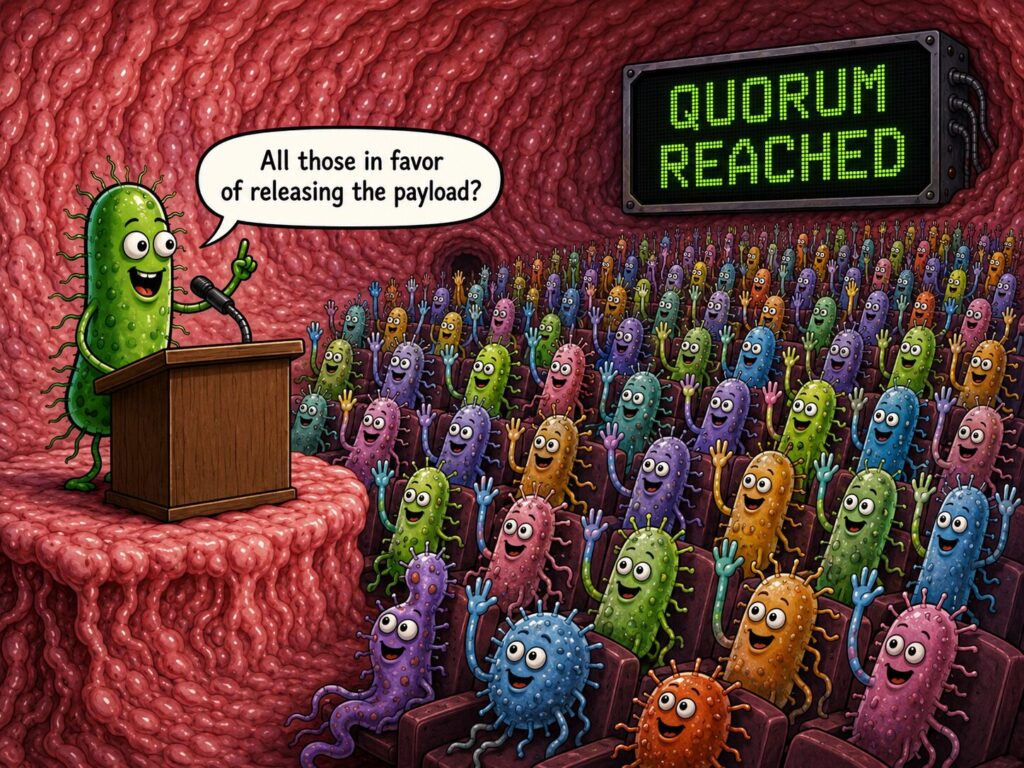
The second challenge was control. An oxygen-tolerant bacterium that kills cancer cells is powerful. Even so, researchers needed to ensure it would not activate that killing function in healthy tissue. The solution was quorum sensing medicine — a natural bacterial communication system. Individual bacteria release small signaling molecules into their environment. When enough bacteria accumulate and the molecule concentration crosses a threshold, the population collectively switches on a gene.
Accordingly, the Waterloo team engineered a quorum sensing medicine circuit so the therapeutic function activates only once bacteria reach sufficient density inside the tumor. Essentially, the bacteria count themselves before acting. Early results appeared in ACS Synthetic Biology in late 2025. Notably, green fluorescent protein confirmed that the synthetic gene circuit activated precisely at the quorum threshold.
Engineered Probiotics and E. coli in Colorectal Cancer
For gut-accessible tumors, the E. coli Nissle therapeutic platform offers another route for bacteria cancer treatment. A 2024 study engineered EcN to detect and treat colorectal neoplasia. The bacterium naturally colonizes immune-excluded tumor environments. Once inside, it releases tumor-killing substances in a targeted manner. A companion approach added a quorum sensing medicine circuit and a synchronized lysis circuit. When the bacterial population reached critical density inside the tumor, it triggered population-wide cell rupture. This released the therapeutic payload all at once.
Meanwhile, a 2025 study from Tianjin University demonstrated an even more sophisticated living therapeutic design. Rather than a single strain, the team built a probiotic consortium — multiple engineered strains working together. This system detected three simultaneous tumor microenvironment signals: pH, hypoxia, and elevated lactate. Depending on what the consortium detected, it released different bacteria drug delivery payloads. One depleted lactate, disrupting tumor metabolism. Another released a PD-L1 nanobody to block the immune checkpoint tumors use to hide from the immune system. In mouse models, the system activated CD8+ and CD4+ T cells and significantly suppressed tumor progression. This is synthetic biology medicine producing something that genuinely resembles biological decision-making.
Safety in Living Therapeutics: Synthetic Gene Circuits That Know When to Stop
A living therapeutic that replicates inside you is powerful. It also raises serious safety questions — and I want to address those directly. What happens if the bacteria spread beyond the target? What if the synthetic gene circuit misfires? What if the organism evolves escape mutations? These are real problems the field is actively solving, and the solutions are as impressive as the therapeutics themselves.
The primary solution is the kill switch, a synthetic gene circuit that forces bacteria to self-destruct outside the intended environment. Two influential designs came from MIT: the Deadman and the Passcode. Specifically, the Deadman switch works on a simple principle. The bacterium must continuously receive a survival signal to stay alive. When it leaves the target environment, that signal disappears. Consequently, the circuit flips to a lethal configuration and the cell destroys itself. The Passcode switch adds further complexity. Survival requires multiple simultaneous inputs, like a combination lock. Therefore, no single environmental signal can accidentally keep the living therapeutic alive in the wrong place.
More recently, synthetic biology medicine has applied CRISPR-Cas9 to this problem. CRISPR-based kill switches detect the absence of a specific molecule. They then cleave the bacterium’s own genome, causing catastrophic DNA damage and cell death. Because the kill mechanism attacks the genome directly, these synthetic gene circuits are much harder for bacteria to evolve around.
Nevertheless, evolutionary stability remains the hardest open problem in living therapeutics. Kill switches impose a fitness cost on bacteria. As a result, natural selection constantly favors mutants that break the circuit. Researchers address this through redundancy — multiple independent kill mechanisms that must all fail simultaneously for an escape mutant to survive. They also engineer the therapeutic genes and the kill switch so they are genetically inseparable. You cannot lose one without losing the other.
Beyond kill switches, researchers use auxotrophic strains as an additional safety layer. These engineered bacteria treatment candidates require a non-natural amino acid to survive. Critically, this amino acid does not exist anywhere in nature. Without it, the bacteria cannot build complete proteins and die. When treatment ends, the supply stops. Predictably, the bacteria clear within days. Clinical-grade live biotherapeutic products now combine auxotrophy, kill switches, and non-colonizing designs. Together, these create multiple independent barriers against uncontrolled persistence.
The safety engineering in living therapeutics is as impressive as the therapeutic engineering: kill switches, auxotrophic strains, and redundant synthetic gene circuits layered to create defense in depth.
Living Therapeutic Products in Human Trials: From Lab to Clinic
Most living therapeutics are still in animal models or early-stage development. However, the field has its first human proof of concept. The disease that validated engineered bacteria treatment in humans is phenylketonuria, or PKU. PKU is a rare metabolic disorder. Patients cannot break down phenylalanine, an amino acid found in most protein-containing foods. Without treatment, phenylalanine accumulates in the blood and causes severe neurological damage. Current management requires a lifelong dietary restriction regimen that is one of the most demanding in all of medicine.
Synlogic is a Cambridge-based synthetic biology medicine company founded on MIT research. Their team engineered an E. coli Nissle therapeutic strain to consume phenylalanine in the gut before it enters the bloodstream. The candidate drug, labafenogene marselecobac (SYNB1934), expresses enzymes that convert phenylalanine into harmless byproducts. Remarkably, it does this at orders of magnitude higher efficiency than any natural strain. The live biotherapeutic product received FDA Fast Track designation. Subsequently, Synlogic completed enrollment in a global Phase 3 pivotal trial in 2024, with top-line data expected in 2025.
Importantly, earlier trials established the critical safety profile. This living therapeutic approach is safe and tolerated in humans. Crucially, no systemic toxicity appeared. Furthermore, the engineered bacteria did not colonize patients long-term — they cleared from the gut within days of stopping dosing. For those of us watching this space closely, this result validated the entire platform. In practice, the therapy can be adjusted, stopped, or modified without lasting consequence. The bacteria simply do not persist after treatment ends.
Beyond PKU, the living therapeutics pipeline is growing. Engineered probiotics are now targeting urea cycle disorders, consuming toxic ammonia in the gut. Engineered bacteria treatment programs are pursuing chronic kidney disease by intercepting uremic toxin precursors. Additionally, several academic and industry groups are advancing synthetic gene circuit designs for inflammatory bowel disease toward clinical evaluation.
The Future of Living Therapeutics and Synthetic Biology Medicine
The living therapeutics field is at an inflection point. Proof of concept is established. The tools of synthetic biology medicine are maturing rapidly. These include synthetic gene circuits, CRISPR editing, quorum sensing medicine, and kill switches. And the diseases where engineered bacteria treatment could matter most, such as cancer, chronic inflammatory disease, and metabolic disorders, represent enormous unmet medical needs.
Several trends are converging. First, synthetic gene circuits are becoming dramatically more sophisticated. Early designs were single-input, single-output: detect one signal, produce one molecule. Today, researchers build multi-input logic gates, memory circuits that remember prior disease states, and oscillating systems that release bacteria drug delivery payloads in controlled pulses. For example, a 2025 paper in Microbiology demonstrated a multi-input circuit in Salmonella. It detects tumor-specific environmental markers and activates localized release of immunostimulatory agents. Living therapeutic circuitry is beginning to resemble genuine decision-making.
Second, the combination of living therapeutics with immunotherapy is opening remarkable new possibilities. Bacteria are naturally immunogenic, meaning that the immune system responds to them. Rather than fighting that response, researchers now design engineered bacteria treatment strategies that exploit it. These strains colonize tumors and simultaneously recruit immune cells, release checkpoint inhibitors, and present tumor antigens. The goal is to convert immune-excluded cold tumors into hot tumors that the immune system actively attacks, using bacteria cancer treatment as the trigger.
Third, bacteria drug delivery innovation is expanding the sites where live biotherapeutic products can act. Most current work focuses on the gut, where oral delivery is straightforward. However, researchers are now exploring intravenous delivery to tumors, direct intratumoral injection, and encapsulation systems. Hydrogels, for instance, protect bacteria as they travel and release them precisely at the target site. Each new delivery route unlocks new disease areas for living therapeutics.
Finally, the regulatory landscape is developing in parallel. The FDA classifies live biotherapeutic products as a distinct category from both conventional drugs and gene therapies. It has issued early guidance on evaluating their safety and pharmacology. The framework is not yet fully mature. Nevertheless, Synlogic’s living therapeutics clinical programs have helped establish the precedents regulators need to see.
The Living Pharmacy: Why Living Therapeutics Are Important
The idea of a living drug is, on its surface, unsettling. Medicine is supposed to be controlled. Bacteria, almost by definition, are not: they evolve, respond to their environment, and multiply. Although these are precisely the properties that make living therapeutics powerful, they must be carefully managed.
Yet the deeper idea here is worth sitting with. Every conventional drug you take is essentially inert. It does one thing, at one concentration, for one duration, regardless of what your body actually needs at that moment. Living therapeutics work differently. For instance, they sense whether inflammation is improving or worsening and adjust in real time. Rather than acting continuously, they stay dormant in the gut until a flare begins, then activate. From there, they navigate to a tumor, assess the microenvironment, and execute bacteria cancer treatment calibrated to what they find. I find this adaptive, localized, and biologically intelligent vision of medicine genuinely compelling in a way that most pharmaceutical innovation simply is not.
To be clear, we are not there yet. The engineered bacteria treatment field is still working through fundamental questions about safety, stability, manufacturing, and clinical translation. The gap between a mouse model and a human patient remains enormous. Moreover, the history of medicine is full of promising ideas that did not survive contact with the complexity of human biology.
Nevertheless, the early results are real. Live biotherapeutic products have consumed toxic metabolites in human clinical trials. Engineered probiotics have shrunk tumors in animals. Bacteria drug delivery systems have detected bleeding in the gut and sealed the wound. Beyond that, living therapeutics have produced therapeutic antibody fragments in response to inflammation signals and delivered them precisely where they were needed. In short, the living drug is no longer a thought experiment.
Now that it has been shown that bacteria can be programmed to act as medicines, the question is how far that programming can go, and whether the safety, manufacturing, and regulatory infrastructure can develop fast enough to bring these living therapeutics to the patients who need them.
Your Thoughts About Living Therapeutics
What do you think? Will living therapeutics become mainstream medicine within the next decade — or do manufacturing, safety, and regulation make that timeline unrealistic?
Does the idea of a replicating organism inside you give you pause, or does the precision outweigh the strangeness? And where do you see the real bottleneck: the science, the regulation, or the business model?
I’d love to hear your perspective in the comments, especially if you work in synthetic biology, clinical development, or patient advocacy.
Bleeding Edge Biology Recommends
For readers who want to go deeper on living therapeutics, engineered bacteria, and the science behind this post.
Articles
Developing a New Class of Engineered Live Bacterial Therapeutics to Treat Human Diseases
Mark R. Charbonneau, Vincent M. Isabella, Ning Li & Caroline B. Kurtz • Nature Communications • April 2020
The clearest published explanation of how the live biotherapeutics platform works end to end. From synthetic gene circuit design to regulatory strategy and manufacturing, written by the Synlogic team itself. Start here if you want to understand what it actually takes to bring an engineered bacterium into clinical trials.
Engineered Bacteria for Disease Diagnosis and Treatment Using Synthetic Biology
Kai Jin, Yi Huang, Hailong Che & Yihan Wu • Microbial Biotechnology • January 2025
A thorough and current survey covering biosensor design, microbial consortia, bacteria cancer treatment, and gut disease. Its treatment of multi-strain systems working in concert is especially useful. Readers who found the cancer and IBD sections of this post compelling will find this review extends both considerably.
“Deadman” and “Passcode” Microbial Kill Switches for Bacterial Containment
Clement T.Y. Chan, Joe H. Lee, Declan E. Taylor, Christopher Voigt & James J. Collins • Nature Chemical Biology • 2016
The foundational paper introducing the Deadman and Passcode kill switch architectures described in this post. It explains the synthetic gene circuit logic behind each design clearly and remains unusually candid about the evolutionary pressures that make kill switches difficult to maintain long-term.
An Engineered Probiotic Consortium Based on Quorum-Sensing for Colorectal Cancer Immunotherapy
Yufei Guo, Mengxue Gao, Lina Wang et al. • Advanced Science • September 2025
A 2025 study demonstrating a probiotic consortium that simultaneously reads three tumor signals and releases coordinated therapeutic payloads through an orthogonal quorum sensing medicine system. It represents one of the most architecturally sophisticated living therapeutic designs published to date.
Sara Sadr, Bahram Zargar, Marc G. Aucoin & Brian Ingalls • ACS Synthetic Biology • December 2025
The University of Waterloo paper behind the tumor-hunting Clostridium work described in this post. Green fluorescent protein confirmed that the synthetic gene circuit activated precisely at the quorum threshold. Readers who want a detailed primary source on quorum sensing medicine in action will find this deeply satisfying.
Talks
Programming Bacteria to Detect Cancer (and Maybe Treat It)
Tal Danino • TED Fellow Talk • May 2015
Bioengineer Tal Danino of Columbia University introduced quorum sensing and bacteria cancer treatment to a mainstream audience in this talk. It remains the best single entry point for readers who prefer to listen before they read. It is short, precise, and still scientifically current.
Hacking Bacteria to Fight Cancer
Tal Danino • TED-Ed Animated Lesson • December 2019
This five-minute animated lesson traces the science from William Coley’s observations to today’s engineered living therapeutics. It covers quorum sensing medicine, the tumor microenvironment, and bacteria drug delivery without requiring any biology background. Ideal for sharing with someone new to the field.
How We’re Using AI to Discover New Antibiotics
Jim Collins • TED • May 2020
Jim Collins co-founded synthetic biology medicine and co-founded Synlogic, the company behind the PKU live biotherapeutic product trial. This talk focuses on AI-driven antibiotic discovery, but the underlying logic of reprogrammable bacteria runs throughout. A valuable window into the field’s founding thinking.
Building With Life in an Era of Biology by Design
Joshua Leonard • TEDxNorthwesternU • July 2018
Northwestern professor Joshua Leonard frames synthetic biology medicine as a design discipline and explains why it enables fundamentally new kinds of medicine. Watch this first if you want intellectual context before zooming into living therapeutics specifically.
Documentaries
Directed by Sarah Schenck & Eugene Jarecki • Featuring Gloria Dominguez-Bello & Martin Blaser (Rutgers University) • 2022
Two Rutgers microbiologists travel the world investigating the destruction of the human microbiome through antibiotic overuse, C-sections, and processed food. This documentary provides the essential backdrop for living therapeutics. The best available film on why the bacterial world inside the body matters before you can appreciate what engineering it might achieve.
Hack Your Health: The Secrets of Your Gut
Directed by Flemming Lytved Hag • Featuring Giulia Enders • Netflix • April 2024
Researchers from Stanford, UC San Diego, and King’s College London explain gut microbiome science through four test subjects. This Netflix documentary makes an accessible primer for readers new to engineered probiotics and the significance of the bacteria already living inside them.
Websites & Resources
Jim Collins, Termeer Professor of Medical Engineering & Science • MIT, Broad Institute & Wyss Institute • collinslab.mit.edu
One of the founding labs of synthetic biology medicine and the group behind Synlogic, the Deadman kill switch, and CRISPR-based diagnostics. This is the best place to track where living therapeutics and programmable synthetic gene circuits are heading in real time.
iGEM Foundation — International Genetically Engineered Machine
Independent non-profit • Founded at MIT, 2003 • igem.org
iGEM runs the world’s largest synthetic biology competition and has trained over 100,000 students across 66 countries using open-source biological parts. Many teams work directly on engineered bacteria treatment and live biotherapeutic product designs. A good resource for understanding both the community and the next generation of researchers building in this space.
Live Biotherapeutic Products — Guidance for Industry
U.S. Food and Drug Administration • Center for Biologics Evaluation and Research • fda.gov
The FDA defines live biotherapeutic products here, explains how they differ from conventional drugs and gene therapies, and sets out the safety and manufacturing data the agency requires. Read this to understand why translating living therapeutics from animal models to human patients takes as long as it does.
Clinical-stage biotechnology company • Cambridge, Massachusetts • Founded 2014 • synlogicbio.com
Synlogic is furthest along in bringing live biotherapeutic products into human clinical trials. Their active Phase 3 PKU program and early-stage work in oncology and IBD make this the most direct way to track how living therapeutics are progressing toward real patients.
Featured image
Gut Bacteria. From NIH image gallery CC BY 2.0