
Were We Intelligently Designed After All?
When people argue about “intelligent design,” they usually picture God or a divine engineer shaping life from outside. I want to take that claim literally and point it in a different direction. In my view, we really were intelligently designed, but the designer was the collective consciousness of our ancestors via sexual selection.
Every generation, we choose partners. In doing so, we choose half the genes of our future children. Over time, those choices, repeated across millions of lives and thousands of generations, have sculpted our bodies, our brains, and our behavior. If you want to understand sexual selection and human evolution, you have to start with a bird that made Darwin queasy.
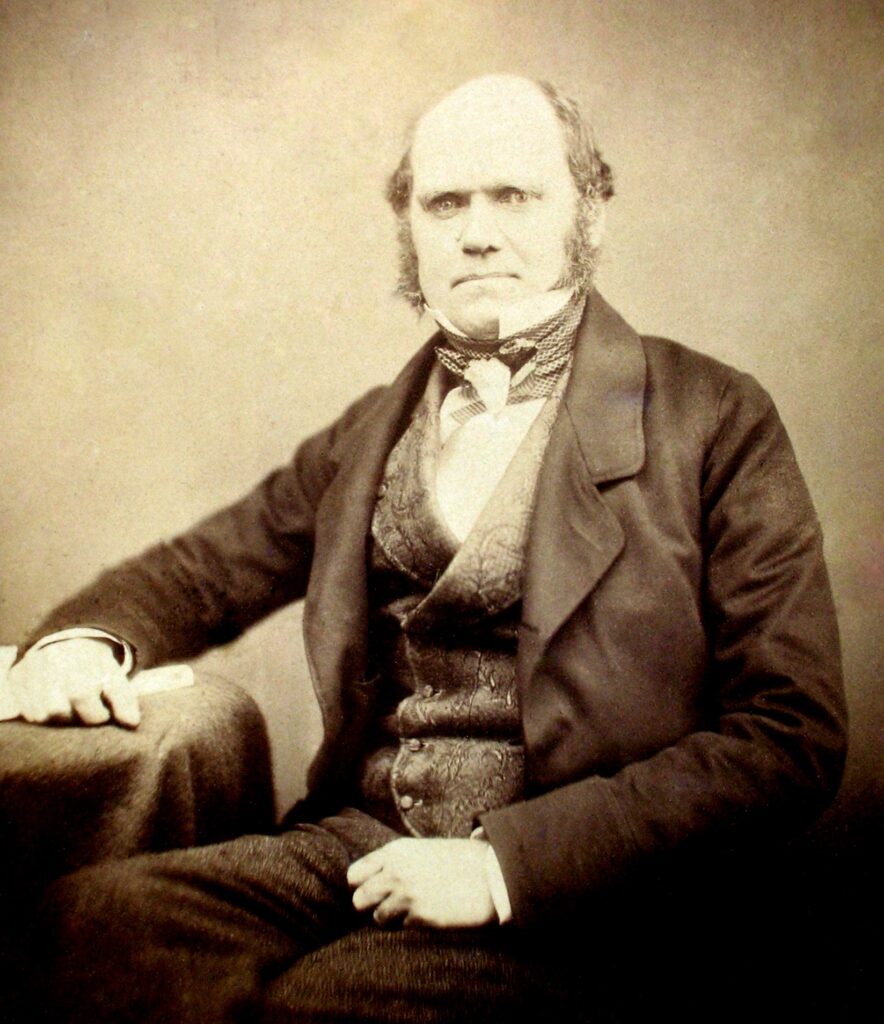
Darwin’s Peacock Problem and Sexual Selection
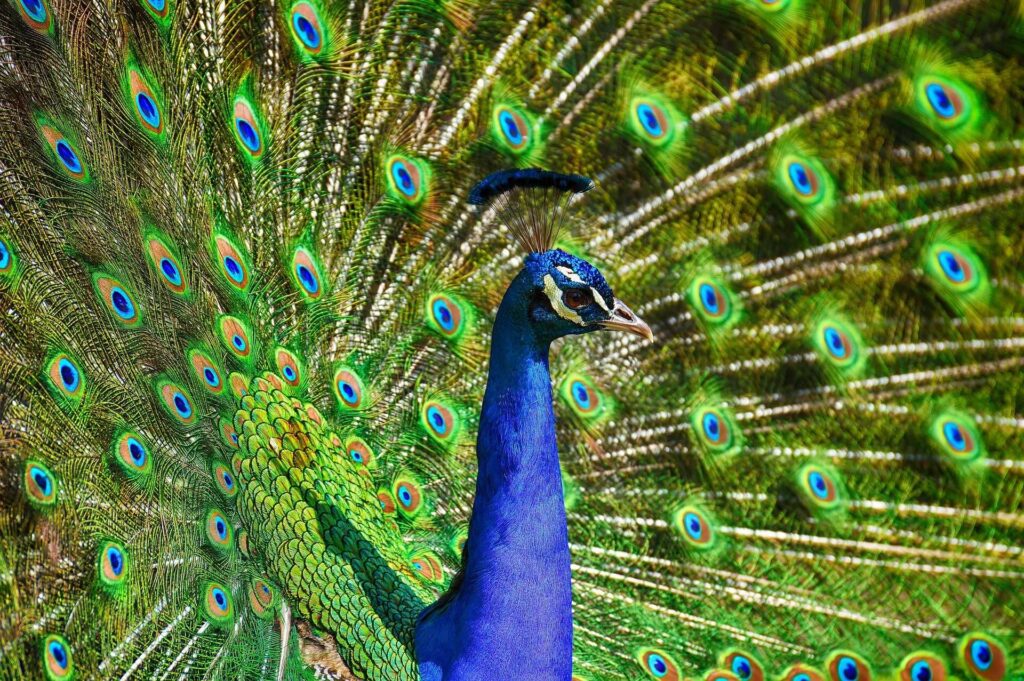
Charles Darwin saw the outline of this idea more clearly than anyone. Natural selection explained how useful adaptations spread: sharper teeth, better camouflage, more efficient wings. However, it did not explain why a male peacock drags around a huge, fragile tail that makes him easier to catch and harder to feed.
Darwin admitted that the sight of a peacock feather made him “sick” at first, because it seemed to contradict his theory. If evolution is about survival, why would nature build such an obvious handicap?
His answer was sexual selection, laid out in detail in The Descent of Man. He argued that evolution runs through two related struggles. One is survival: finding food, avoiding predators, resisting disease. The other is reproduction: defeating rivals and persuading potential partners to choose you.
Sexual selection covers that second struggle. Some characters help you fight rivals with antlers, tusks, and large body size. Others help you win attention, using bright plumage, complex songs, dances, scents, and in humans, things like humor and confidence. From the start, Darwin saw that sexual selection and human evolution were tightly linked, even if many readers missed the point.
The Scandal of Female Choice in Human Evolution
Darwin also put special weight on female choice. In many species, females attend closely to male color, song, and behavior. Their “taste for the beautiful,” as Darwin put it, can drive the evolution of elaborate ornaments.
This idea was met with deep skepticism. Many of his contemporaries thought it was absurd to credit animals, especially females, with that much agency. Instead, they treated female choice as sentimental and unscientific. They preferred explanations based on male–male combat or simple survival advantages.
As a result, through much of the early twentieth century, sexual selection was downplayed. Evolutionary biologists focused on natural selection for survival and treated sexual selection as a niche idea, or even as a mistake on Darwin’s part. Only later did researchers recognize how central sexual selection is for understanding human evolution and the striking diversity of animal displays.
Fisherian Runaway: When Sexual Selection Runs Wild
Ronald Fisher helped change that. As one of the founders of modern population genetics, he took sexual selection seriously and worked out how it could run away.
The mechanism now called Fisherian runaway is simple and powerful. To see how it works, imagine that females have a slight genetic preference for a particular feature, say, a tail that is a bit longer than average. Males with slightly longer tails win more mates.
Their offspring inherit both the longer tails and the preference for them, because both characters are heritable. Over many generations, preference and character reinforce one another. Tails lengthen, the bias toward long tails strengthens, and the system can spiral outward.
This logic later became associated with what Patrick Weatherhead and Raleigh Robertson called the sexy son hypothesis: females that choose attractive males may gain an indirect advantage because their sons will inherit those attractive characters and enjoy greater mating success themselves.
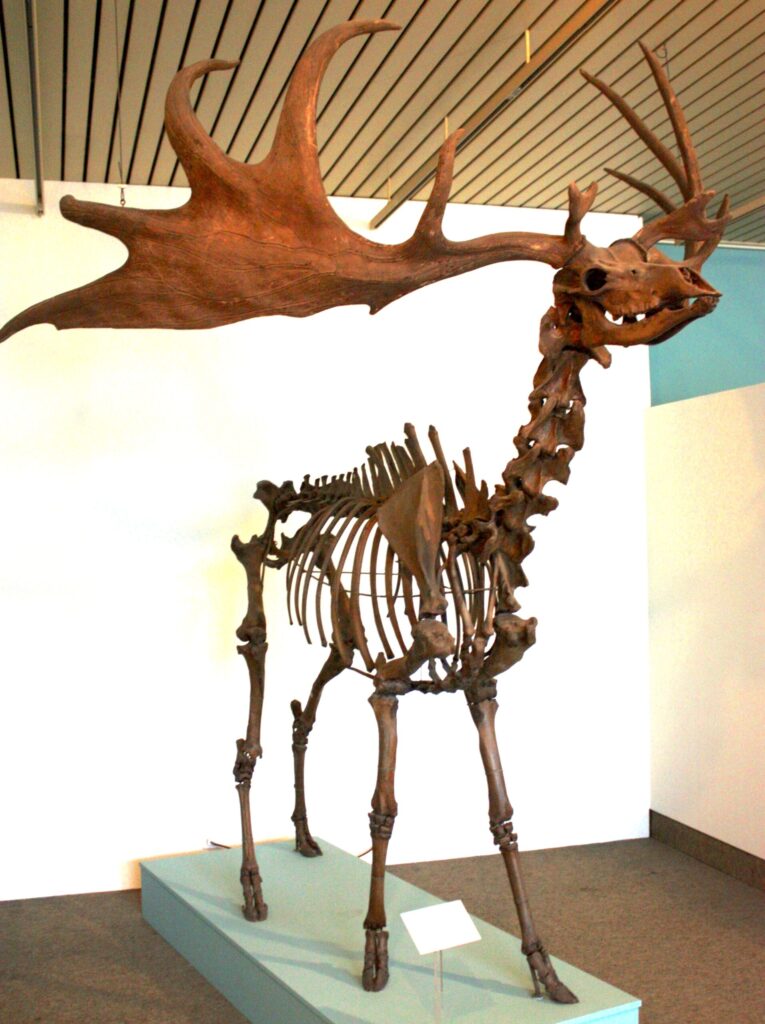
At some point, natural selection pushes back when the ornament becomes too costly. Even so, by then you may have an enormous display structure that makes little sense if you think only about survival. The Irish elk is often cited as a possible example. Its gigantic antlers, shaped by sexual selection, could reach about 12 feet from tip to tip and weigh roughly 88 pounds. Some researchers have argued that a continuing preference for such extreme antler size may have left the species poorly matched to changing environments, even if climate change and perhaps human pressure were the more immediate causes of its extinction.
This runaway process is one of the key mechanisms behind the extravagant, and sometimes absurd, characters seen across the tree of life.
The Puzzle of Evolution’s Strangest Features
Runaway dynamics help explain why sexual selection produces extravagance everywhere in nature. Yet they also push us toward the oddest parts of human nature: art, music, and other forms of creativity that seem wildly out of scale if we only count survival.
Evolutionary thinkers, including Steven Pinker, have wrestled with this problem. Painting landscapes or composing symphonies does not obviously keep people alive. Pinker famously called the arts “cheesecake for the mind,” a rich dessert that overstimulates mental circuits originally shaped for more practical tasks such as language and pattern recognition. On that view, art and music are evolutionary side effects.
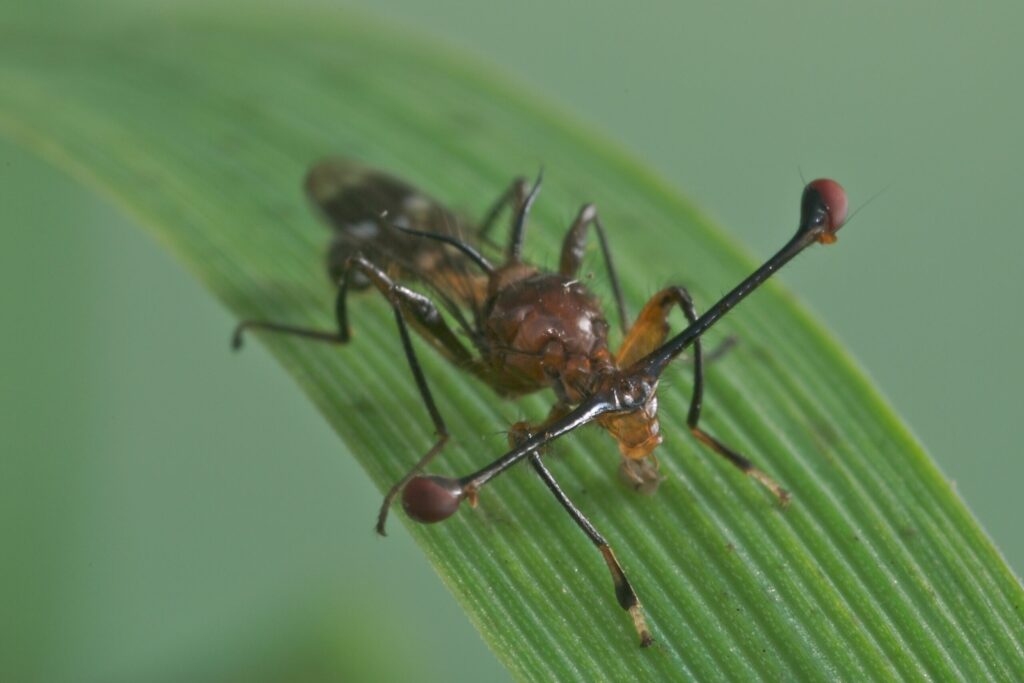
I do not think that story is enough on its own. After all, we see some of the same puzzles in other species: elaborate songs, intricate dances, bizarre ornaments that look more like performance than practicality. If we want to understand sexual selection and human evolution, we have to ask why evolution keeps investing in characters that look like shows.
Sexual Selection as Evolution’s Venture Capital
In his book “The Mating Mind” Geoffrey Miller extends that logic with a modern twist. He argues that sexual selection can act as evolution’s venture capitalist. Natural selection is usually strict about immediate utility. Sexual selection can keep a costly novelty alive because potential mates find it attractive. In that way, mate choice can give evolution more room to experiment.
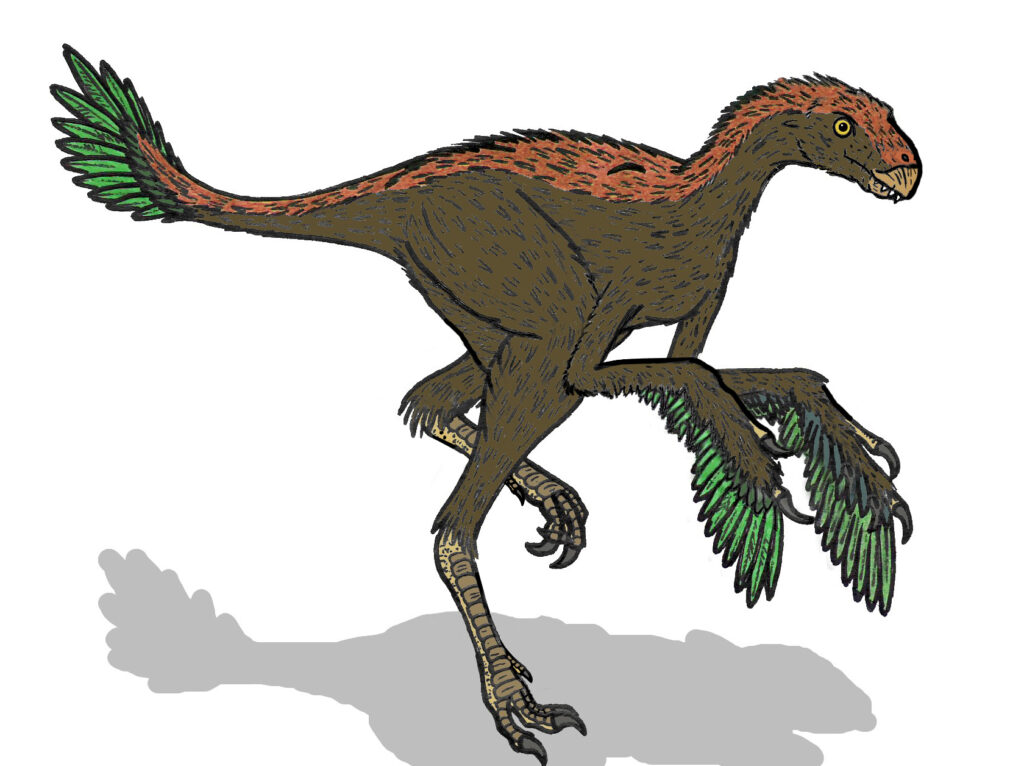
One possible example is the origin of wings. Some researchers have suggested that feathered forelimbs may first have been elaborated in part as display structures, only later becoming useful for flight. The point is that mate choice may sometimes help build a structure beyond its initial practical value, making new functions possible later.
Miller’s main example, though, is the human mind. A large brain is metabolically expensive, yet traits such as intelligence, humor, creativity, and social sensitivity are also attractive in mates. Sexual selection, on this view, may have helped sustain a level of mental extravagance that survival needs alone would have been less likely to produce.
Sexual Selection and the Mating Mind
This idea becomes easier to see when you look at human courtship. Across cultures, art, music, dance, storytelling, wit, style, and verbal skill cluster around attraction. People perform when they want to be noticed. They sing, joke, dress carefully, show social fluency, and display taste.
Even activities that look private often feed reputation and desirability. Writing, composing, drawing, building, and public speaking all advertise something about the mind behind them. They signal memory, discipline, imagination, and emotional intelligence.
Seen in that light, many of our most distinctive mental abilities look like displays. Sexual selection does not explain the whole human mind, but it may help explain why our intelligence became so expressive, excessive, and tied to performance in the first place.
What You Find Attractive
The same logic applies in quieter ways. Everything you reliably find attractive about the opposite sex has a history in sexual selection.
For instance, consider faces. Most of us respond positively to certain ranges of symmetry and proportion and feel uneasy when features fall far outside those ranges. Consider body shape and posture, the pitch and tone of a voice, the way someone moves through a room.
Then think about less visible but powerful characters: a sense of humor, kindness, generosity, emotional steadiness, the ability to read social cues and respond gracefully. Some preferences are personal or cultural, but many follow broad patterns that show up again and again across societies.
From an evolutionary standpoint, individuals who ignored those cues, or who preferred characters others found less desirable, left fewer descendants.
Desire as a Sense Organ
Over thousands of generations, that small difference reshaped what feels attractive and what feels dull, off, or repellent. This is how sexual selection and human evolution work together: desire keeps sampling the population, and the population slowly shifts toward what desire keeps choosing.
Desire behaves like a sense organ aimed at other people’s bodies and minds, trained by the history of selection. When your attention is pulled toward certain faces, voices, or ways of behaving, you are feeling a very old filter at work, revised by countless choices long before you were born.
That filter is the living trace of sexual selection, written into your nervous system by the long interplay between sexual selection and human evolution.
Sexual Selection as a Designer
This is where sexual selection starts to look like a kind of intelligent design.
No single person decides what a “good” mate looks like. Instead, a species-wide aesthetic standard emerges from the combined choices of many individuals, each with their own biases and limited information.
Those individuals still function as designers in a narrow but real sense. They carry standards in their nervous systems. They test variants whenever they date, flirt, or weigh a potential partner. As a result, each yes and no adjusts the distribution of characters in the next generation.
The process is not wise or gentle. Sexual selection can drive characters to wasteful extremes and amplify harmful status competitions. In humans, it can latch onto displays of wealth, power, or risk taking that damage both individuals and societies.
Intelligence, creativity, and beauty come with costs. Sexual selection does not guarantee good outcomes. However, it does provide direction. It pushes certain signals and capacities forward, generation after generation, because they keep passing a test in the eyes and ears of potential partners.
In the Image of Our Creator
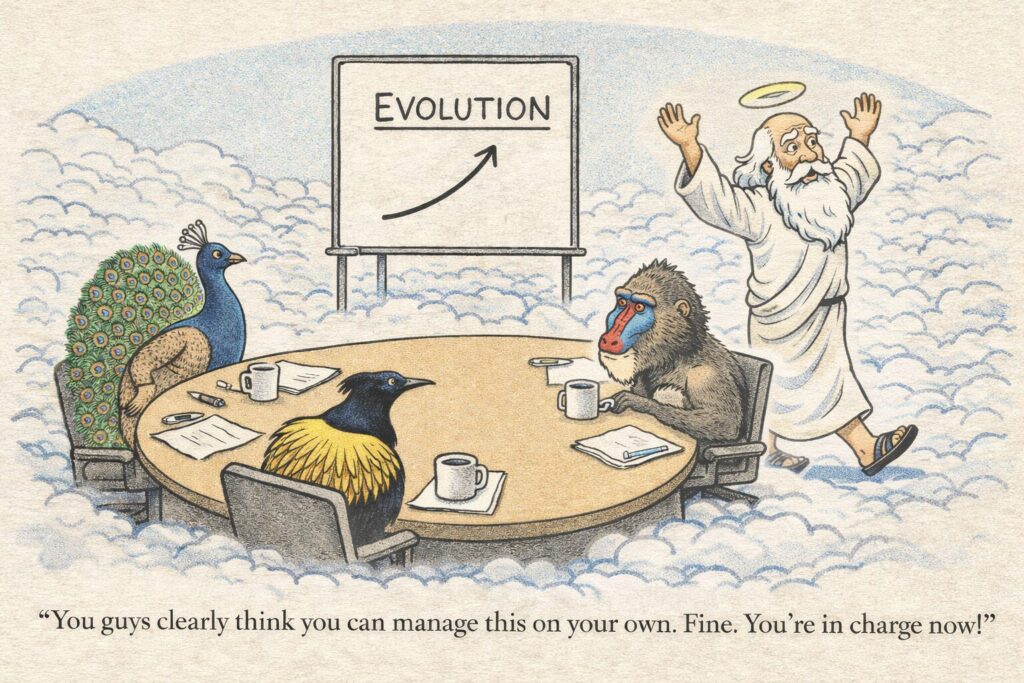
All of this brings us back to an old religious claim: that we were created by God and made in the image of our creator.
Seen through the lens of sexual selection and human evolution, there is a strange and humbling sense in which this is true. Our bodies and brains bear the imprint of countless choosers stretching back through human and prehuman history. We are shaped by their tastes, their fears, their attractions, their judgments about who was desirable and who was not.
So if there is an “image of our creator” written into us, that image is us. It is the composite face of all those who chose and were chosen who picked half the genes of the next generation, over and over again.
Materials for further study
Books
Charles Darwin – The Descent of Man, and Selection in Relation to Sex
Where all of this starts. Darwin lays out his theory of sexual selection, including female choice, beauty, and an early version of what we now call runaway selection.
Malte Andersson – Sexual Selection (1994)
A classic technical overview of sexual selection in animals. Dense but clear, with chapters on mate choice, ornaments, and the formal models that grew out of Fisher’s ideas.
Geoffrey Miller – The Mating Mind: How Sexual Choice Shaped the Evolution of Human Nature
A full length argument that human art, music, humor, and much of our intelligence evolved as courtship displays under sexual selection.
Richard Prum – The Evolution of Beauty: How Darwin’s Forgotten Theory of Mate Choice Shapes the Animal World—and Us
Revives Darwin’s “taste for the beautiful” and argues for an explicitly aesthetic view of mate choice, with implications for human sexuality and politics.
Michael Ryan – A Taste for the Beautiful: The Evolution of Attraction
Uses frogs, fish, and other systems to show how sensory biases and preferences drive the evolution of beauty.
Articles and academic reviews
Andersson, M. & Simmons, L. W. (2006). “Sexual selection and mate choice.” Trends in Ecology & Evolution
A compact review of how sexual selection theory has developed since Darwin, including why females might prefer ornamented males.
Jones, A. G. & Ratterman, N. L. (2009). “Mate choice and sexual selection: What have we learned since Darwin?” PNAS
Accessible overview of the modern evidence for mate choice, including genetic models and experimental tests.
Prum, R. O. (2012). “Aesthetic evolution by mate choice: Darwin’s really dangerous idea.” Philosophical Transactions of the Royal Society B
Develops the idea that mate preferences can have their own evolutionary history, not always tied to survival benefits.
Rosenthal, G. G. (2022). “Sexual selection and the ascent of women: Mate choice research since Darwin.” Science
A short, sharp piece on how Darwin’s ideas about female choice were sidelined and why they matter again now.
Geoffrey Miller – “Sexual Selection and the Mind” (Edge.org essay)
A readable summary of Miller’s view that many aspects of human psychology are best understood as courtship displays.
Talks and videos
David Buss – “Sexual conflict in human mating” (TEDxVienna)
Buss outlines how sexual selection plays out in human relationships, focusing on conflicts between male and female interests.
David Puts – “To find your perfect mate, think like an evolutionist” (TEDx)
A good introduction to human mate preferences, competition, and the logic of sexual selection in everyday attraction.
Dawn Maslar – “The science of attraction” (TED-Ed)
Short animated explainer on how our senses and brains evaluate potential partners.
Geoffrey Miller – “Evolution & Conspicuous Consumption” (TEDxABQ)
Connects sexual selection to consumer behavior and status displays, with clear links back to the peacock’s tail.
Richard Prum – “Evolution and Beauty” (public lecture)
Prum walks through his aesthetic view of sexual selection with lots of bird examples and a strong Darwinian through line.
“The Evolution of Beauty” (documentary project inspired by Prum’s book)
A film project built around Prum’s argument about aesthetic mate choice in birds and humans. Worth watching for the visuals even if you’ve read the book.
Podcasts
Science of Birds – “Mate Choice and Sexual Selection in Birds”
Clear, structured introduction to sexual selection using birds as a model system; good for grounding the abstract theory in concrete examples.
Common Descent Podcast – Episode 63: “Sexual Selection”
A relaxed but informative walkthrough of sexual selection, from basic definitions to weird edge cases.
Huberman Lab – “How Humans Select & Keep Romantic Partners in Short & Long Term | Dr. David Buss”
Long form discussion of mate choice, short term vs long term strategies, deception, jealousy, and how evolutionary thinking can illuminate human relationships.
BioAudio – “Mate Choice, Parental Investment, Competition and Sexual Selection”
A more classroom style episode that ties together sexual selection, parental investment theory, and costly characters.