
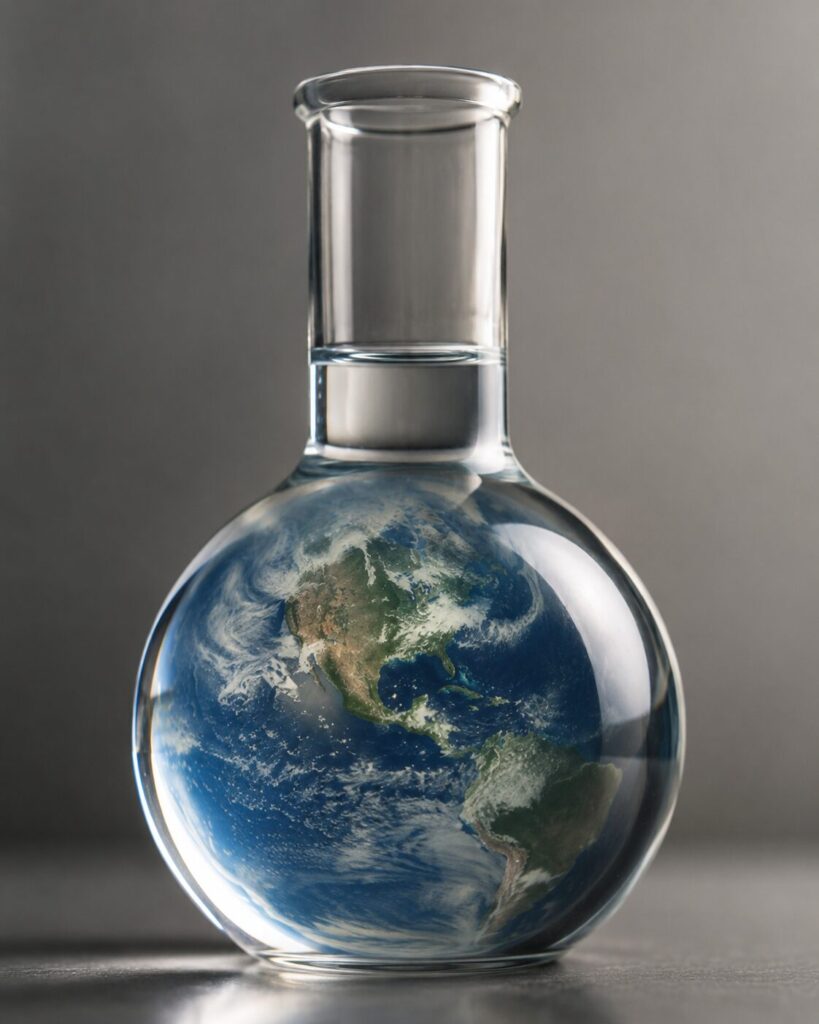
Every living thing runs on metabolism. Now we are building it from scratch.
Metabolism is the sum of all the chemical reactions that keep an organism alive. Breaking things down, building things up, moving energy around. Life figured out metabolism roughly four billion years ago. It has been running largely the same chemistry ever since. Artificial metabolism asks what happens when we design that chemistry ourselves.
Now researchers are building artificial metabolism systems from scratch. These systems run entirely outside any living cell. They require no membrane, no DNA, no ribosomes. Instead, they consist of sequences of engineered enzymes, arranged in a specific order, doing chemistry that no natural organism has ever performed. Feed them carbon dioxide pulled from industrial waste streams or the atmosphere, and they produce acetyl-CoA, one of the most fundamental building blocks of life. From there, the same artificial metabolism system can manufacture bioplastics, pharmaceutical precursors, and other useful chemicals. The feedstock is pollution. The product is material.
For decades, we have engineered living cells to make things for us. Artificial metabolism cuts the cell out entirely. What remains is pure chemistry, designed by researchers, running on atmospheric waste.
What Is Artificial Metabolism, and What Does It Mean to Build One?
Metabolism is, at its core, an assembly line. In a living cell, that assembly line converts raw materials into energy and useful molecules. Each step is catalyzed by an enzyme. Each enzyme takes a molecule, transforms it, and passes the result to the next enzyme in the sequence. The system runs continuously, adjusting in real time to what the cell needs.
For most of the history of biotechnology, researchers worked with that assembly line rather than around it. You engineered a microbe. You modified its genes so the cell’s own metabolism produced something useful: insulin, ethanol, a fragrance compound. The cell did the work. You collected the product.
That approach has real limits, however. Living cells have their own priorities. They divert resources toward growth and reproduction. They respond to stress by shutting down useful pathways. They produce byproducts you do not want. Furthermore, they operate only within the narrow range of conditions that keep them alive: specific temperatures, pH ranges, oxygen levels. In short, you are always negotiating with the cell.
Cell-free biology takes a different approach. You extract the desired enzymes and run the reactions directly, in a test tube, without the cell at all. This is the founding premise of artificial metabolism.
The Roots of Artificial Metabolism: Running Chemistry Without a Cell
The idea of doing biology outside a living cell is older than most people realize. In 1961, Marshall Nirenberg and Heinrich Matthaei used a cell-free protein synthesis system to help solve the genetic code. They extracted the cellular machinery from E. coli and used it to translate synthetic RNA into protein in a test tube. It was one of the landmark experiments of molecular biology.
Researchers have built on that foundation for sixty years since. Cell-free protein synthesis systems are now standard research tools. You can buy commercial kits off the shelf. Pharmaceutical companies use them to produce experimental proteins rapidly, bypassing the weeks of cell culture that conventional fermentation requires. Vaccine developers used cell-free systems during COVID-19 to prototype antigens faster than traditional methods allowed.
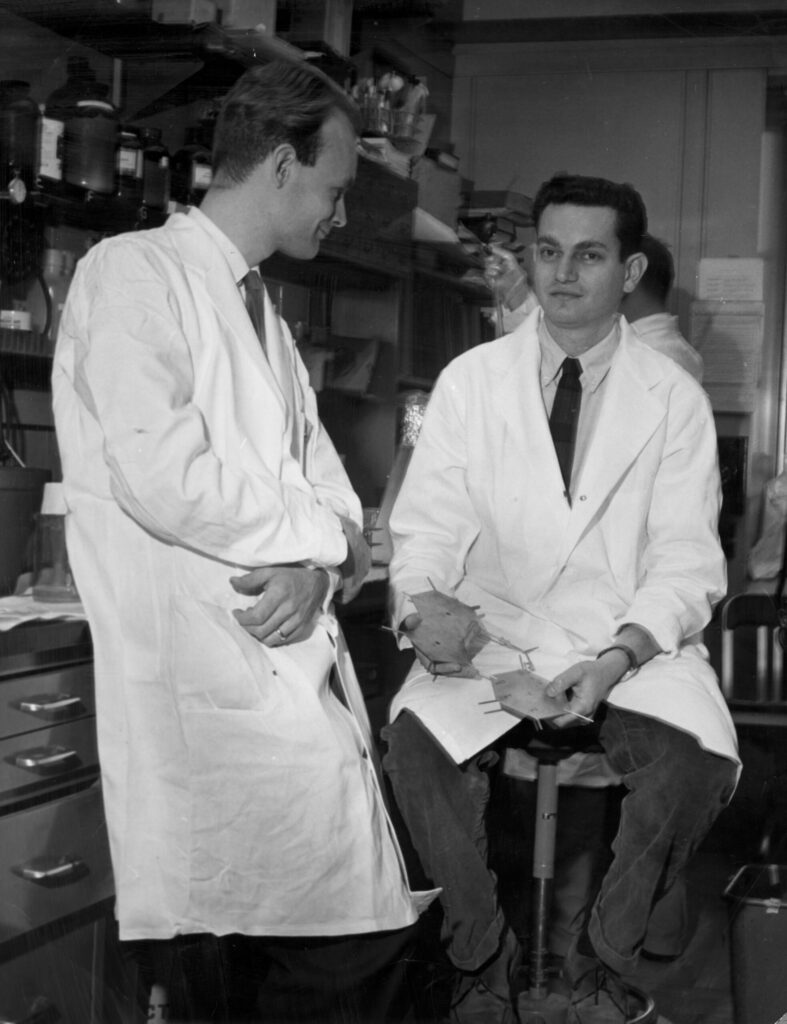
Protein synthesis, however, is only one piece of metabolism. For a long time, extending cell-free biology beyond protein production seemed out of reach. Metabolic pathways involve many reactions in sequence, each requiring a different enzyme, often sharing cofactors and regulatory interdependencies. Getting those reactions to work together without the cellular infrastructure that evolved to support them is genuinely hard.
Nevertheless, the field has been advancing steadily. Over the past decade, researchers have assembled multi-step cell-free metabolic pathways for producing hydrogen, synthesizing complex natural products, and building fine chemicals from simple feedstocks. Artificial metabolism is the name this broader ambition has earned.
Building Artificial Metabolism from Scratch: The Engineering Challenge
This is the part I think deserves more attention than it usually gets. Assembling artificial metabolism outside a cell is not like mixing chemicals in a bowl. Each step requires an enzyme that accepts a specific substrate, produces a specific product, and operates under the same conditions as every other enzyme in the sequence. Getting those conditions to align across many reactions simultaneously is a genuine design problem.
Natural enzymes evolved for natural substrates. If you want a reaction that nature never invented, you need an enzyme that nature never made. That means engineering one from scratch or borrowing an enzyme from a different biological context and modifying it until it performs a new job.
Additionally, enzymes depend on cofactors: small helper molecules that carry electrons or chemical groups from one reaction to the next. In a living cell, the cell continuously regenerates these cofactors. In an artificial metabolism system, you manage that regeneration yourself. If cofactors run out, the pathway stops. Balancing cofactor supply across multiple simultaneous reactions is one of the central technical challenges of cell-free metabolism.
The screening process alone is enormous. To find enzymes with the right properties, researchers test hundreds or thousands of candidates, evaluate variants, and iterate on concentrations and enzyme loadings. Crucially, this process runs much faster in a cell-free format. You can test many enzyme variants in parallel, without keeping anything alive, without waiting for microbial growth. That speed is one of the field’s most underappreciated advantages.
ReForm: Artificial Metabolism as a Proof of Principle
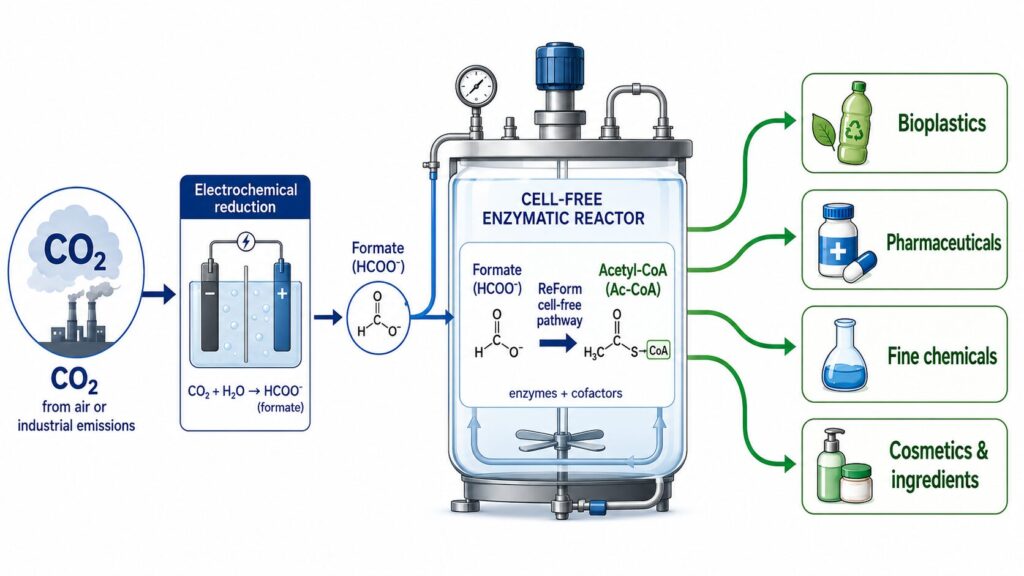
Against that backdrop, a result published in Nature Chemical Engineering in April 2026 stands out as a meaningful proof of principle for artificial metabolism. Researchers at Northwestern and Stanford assembled a six-step synthetic metabolic pathway, which they named ReForm, for Reductive Formate Pathway. It converts formate directly into acetyl-CoA. The pathway runs entirely outside living cells. No membranes. No DNA. Six enzymes doing chemistry in sequence.
Formate is a simple one-carbon molecule. You can produce it cheaply by running electricity through CO2, a process called electrochemical reduction. So the full chain works like this: take CO2 from the air or from industrial waste streams, convert it electrochemically to formate, and then feed the formate to the ReForm system, which converts it to acetyl-CoA.
Acetyl-CoA is a fundamental metabolic hub. Your cells use it constantly. When your body breaks down carbohydrates, fats, and proteins, it funnels many of the products into acetyl-CoA. From there, the molecule enters the citric acid cycle to generate energy. It also serves as the starting point for synthesizing fatty acids, cholesterol, and many other essential molecules. Reaching acetyl-CoA from CO2 opens access to a vast range of downstream chemistry.
The team demonstrated this access directly. They added a malate synthase enzyme to the ReForm system and produced malate, a commercially valuable molecule used in foods, cosmetics, and biodegradable plastics, from CO2-derived formate. Furthermore, the pathway accepted multiple carbon sources: formaldehyde and methanol both worked alongside formate, giving the system unusual flexibility.
The enzyme screening involved 66 initial candidates and over 3,000 engineered enzyme variants. Five of the six pathway steps are entirely new to nature. No known organism performs these reactions. The researchers designed artificial metabolism chemistry that evolution never produced.
What Artificial Metabolism Unlocks: From CO2 to Products
Acetyl-CoA sits at a metabolic crossroads. Consequently, an artificial metabolism system that produces it from CO2 opens a wide range of downstream possibilities, in both materials and medicine. To appreciate why that is significant, it helps to understand what those possibilities are replacing.
The Plastic Problem Is Also a Carbon Problem
We produce roughly 400 to 500 million tonnes of plastic every year. That number has grown 260-fold since 1950. Of all the plastic ever manufactured, only about 9 to 10 percent has ever been recycled. The rest sits in landfills, floats in oceans, or breaks down into microplastics that now turn up in human blood, breast milk, and Arctic ice cores. Approximately 11 million tonnes of plastic enter the ocean annually. That is equivalent to emptying 2,000 garbage trucks into the world’s oceans, rivers, and lakes every single day.
Conventional plastic production makes all of this worse in a second way. Almost all plastic comes from petroleum. Extracting the oil, refining it, synthesizing the plastic polymers, and eventually disposing of the material all emit greenhouse gases. In 2019, production of virgin plastic generated roughly 2.24 billion tonnes of CO2 equivalent, around 5.3 percent of global greenhouse gas emissions. For context, that is four times the emissions of the entire aviation industry. Under current growth projections, plastic production could consume between 21 and 31 percent of the remaining carbon budget for limiting warming to 1.5 degrees Celsius by 2050.
So the plastic problem and the climate problem are not separate issues. They are the same system. Petroleum goes in at one end, plastic and CO2 come out at the other. That loop has been running for seventy years, and it is accelerating.

Running the Loop in Reverse
Instead of starting with petroleum and producing both plastic and CO2, you start with CO2 and produce plastic. The feedstock is the waste. The product is the material. Furthermore, the bioplastics this pathway produces are biodegradable. They do not persist in the ocean for centuries. They break down naturally, closing a loop that petroleum-based plastic never could.
The specific product the ReForm team demonstrated is malate, a commercially valuable molecule used in biodegradable plastics, foods, and cosmetics. Beyond malate, acetyl-CoA feeds biosynthetic pathways for polyhydroxyalkanoates, or PHAs, a family of biodegradable polymers already used in packaging and medical devices. Crucially, when PHAs degrade, they do not fragment into persistent microplastics. They break down into water and CO2, completing a genuinely circular carbon cycle.
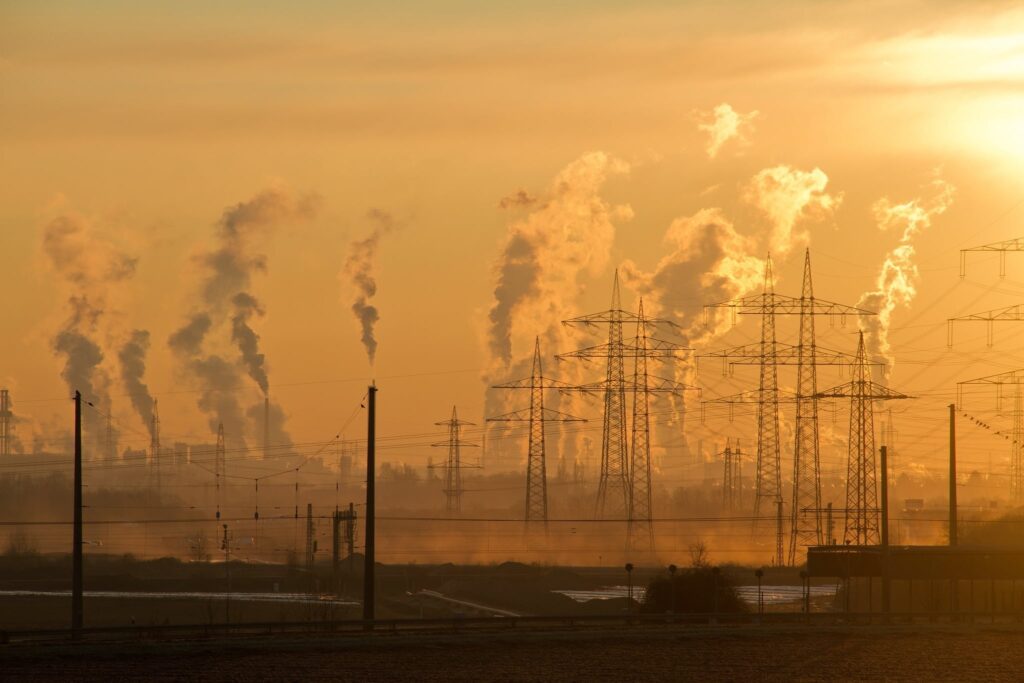
The carbon source for all of this is industrial CO2 that would otherwise enter the atmosphere. Power plants, cement factories, and steel mills all produce concentrated CO2 waste streams. Currently, capturing and storing that CO2 is expensive and technically difficult. An artificial metabolism system that converts that CO2 directly into useful materials changes the economics entirely. The waste stream becomes a feedstock. Carbon capture becomes carbon manufacturing.
Beyond Plastics: Medicines and the Fermentation Problem
Pharmaceutical synthesis is another direction worth taking seriously. Many drug precursors derive from acetyl-CoA in living cells. Statins, terpene-based medicines, and certain antibiotic precursors all trace back to this molecule. Currently, producing these compounds requires large-scale fermentation: enormous bioreactors, temperature-controlled environments, significant water use, and weeks of microbial culture time. Fermentation also produces waste streams of its own.
An artificial metabolism system that produces acetyl-CoA from CO2 could, in principle, supply pharmaceutical precursors without fermentation. That reduces energy and water consumption, shortens production timelines, and eliminates much of the biological waste. Additionally, it decouples pharmaceutical manufacturing from agricultural feedstocks like glucose, which compete with food production and carry their own environmental footprint.
Beyond specific products, the deeper ecological shift is this: artificial metabolism turns carbon from a liability into a resource. Every industrial process that currently emits CO2 could, in principle, become a feedstock supplier. The scale of that opportunity is not yet matched by the scale of the technology. Nevertheless, the direction is clear, and the chemistry is real.
The Honest Limitations of Artificial Metabolism
From Lab Demonstration to Manufacturing Platform
I want to be direct here. The gap between a lab demonstration and an industrial process is very large. ReForm is a proof of principle for artificial metabolism. It is not yet a manufacturing platform, and several serious obstacles remain. None of them undermine the ecological logic. They do, however, determine how quickly that logic can be put to work at meaningful scale.
Enzyme stability is the first. In a living cell, enzymes are continuously replaced as they degrade. In an artificial metabolism system, there is no replacement mechanism. Enzymes wear out over time. Currently, that limits how long the system can run continuously without intervention. Until enzyme stability improves substantially, continuous large-scale operation is not yet viable.
Cofactor cost is the second. The ReForm pathway uses NAD(P)H and CoA as cofactors, both of which are expensive molecules. In a small lab experiment, that cost is acceptable. In large-scale industrial production, it becomes a serious economic problem unless efficient cofactor recycling is built into the system, which adds further engineering complexity.
Scale, Energy, and the Carbon Accounting Problem
Scale-up is the next challenge. Running six enzyme reactions in a one-milliliter test tube is one thing. Running those same reactions continuously in a large-scale reactor, with mixing, heat management, and product separation, is a different engineering problem entirely. Multi-step artificial metabolism pathways have not yet been demonstrated at industrial scale.
Finally, the environmental case depends on the electricity source. The electrochemical reduction step that converts CO2 to formate requires electrical energy. If that energy comes from fossil fuels, the carbon accounting changes considerably. The full ecological benefit of artificial metabolism is only realized when paired with renewable power. That pairing is increasingly feasible as the cost of solar and wind continues to fall, but it cannot be assumed.
None of these limitations are fundamental scientific dead-ends. They are engineering problems, and engineering problems yield to iteration.
What Artificial Metabolism Changes About Synthetic Biology
Biology Without the Cell’s Agenda
The conceptual shift behind artificial metabolism runs deeper than ReForm’s specific chemistry. Living cells are powerful manufacturing systems, but they carry their own agenda. They evolved to survive and reproduce. Any product we want them to make remains secondary to those priorities. That creates a constant negotiation in cell-based biotechnology. Researchers redirect cellular resources, but the organism still spends energy on growth, repair, stress responses, and reproduction. Those competing demands can reduce yield and complicate production.
An artificial metabolism system has no agenda. You load the enzymes, supply the substrates and cofactors, and the reactions proceed. You control the concentrations, temperature, timing, and pathway structure. The system does what you design it to do. That precision is especially useful for industrial waste streams. If the goal is to process carbon at scale, predictability becomes valuable. Artificial metabolism gives researchers a way to design chemistry without managing a living organism.
Modular Chemistry, Faster Design, and Biosafety
Artificial metabolism also offers a kind of modularity that living cells cannot easily match. You can add or remove enzymes the way an engineer might swap components in a circuit. To extend the pathway, add another enzyme. To test a new carbon source, replace one step. That modular structure can speed up design cycles. Researchers can test enzyme combinations without waiting for microbial growth or rebuilding an organism’s genome. The pathway becomes a biochemical platform rather than a living cell line.
There is also a biosafety dimension worth noting. An artificial metabolism system cannot evolve, reproduce, or disperse into the environment the way a living engineered organism can. For industrial-scale carbon conversion applications, that removes an entire class of environmental concerns. You are not releasing anything alive. The system runs in a reactor, processes a feedstock, and produces a product. When it stops running, it stops.
Taken together, these properties suggest artificial metabolism will develop as a parallel track alongside conventional cell-based synthetic biology. Each approach suits different applications. One keeps the organism and reprograms it. The other keeps the chemistry and discards the organism entirely. For the specific challenge of turning atmospheric carbon into useful materials at industrial scale, the cell-free approach has significant structural advantages.
Artificial Metabolism: Two Directions from the Same Departure Point
Living Therapeutics Keep the Cell
In a recent post on living therapeutics, I wrote about bacteria engineered to sense disease and treat it from inside the body. That field keeps the cell. It depends on the cell, because the cell’s ability to replicate, sense its environment, and produce molecules on demand is the therapeutic mechanism itself.
Artificial metabolism runs in the opposite direction. It extracts the chemistry from the cell and runs it in a controlled environment, using engineered enzymes performing reactions that evolution never invented. No organism required. No negotiation with a living system. Just designed chemistry, running on waste CO2.
Both approaches came from the same intellectual origin: the recognition that biological chemistry is programmable. You can read the instructions, rewrite them, and build systems that produce things nature never naturally made. One keeps the organism. The other keeps the chemistry. Which you choose depends on what you are trying to do.
Artificial Metabolism and the Carbon Problem
For the specific challenge of decarbonizing materials manufacturing, artificial metabolism makes a compelling case. We already have a CO2 problem. We already have a plastic problem. These are not separate crises — they share a cause, which is our dependence on petroleum as both an energy source and a raw material. A technology that converts CO2 into biodegradable materials without petroleum touches both problems simultaneously. That is genuinely unusual.
ReForm will not overturn conventional chemistry or replace petroleum-based manufacturing tomorrow. However, it does demonstrate that artificial metabolism — a complete synthetic pathway converting an atmospheric waste gas into a universal biochemical building block — can run outside a living cell. That is a meaningful step in a longer research program. I think the most interesting applications of artificial metabolism are still years away. Nevertheless, the direction is clear, and the underlying logic is sound.
We have spent seventy years pulling carbon out of the ground, making things with it, and releasing it into the atmosphere. Artificial metabolism suggests a different arrangement: pull it from the atmosphere, make things with it, and keep it out of the atmosphere for as long as possible. That is worth working toward.
Your Thoughts
What do you think? Artificial metabolism offers a route to materials manufacturing that consumes carbon rather than producing it. But the gap between a lab proof of principle and an industrial process is long. Do you think the technology will develop fast enough to make a meaningful dent in plastic production within this decade — or is that timeline optimistic?
And where do you see the strongest near-term application: bioplastics, pharmaceuticals, or carbon conversion at industrial sites like power plants and cement factories? I’d particularly love to hear from anyone working in materials science, industrial biotech, or carbon capture — this is a field where the chemistry and the economics need to develop in parallel, and the path is not yet obvious.
Bleeding Edge Biology Recommends
For readers who want to go deeper on cell-free biology, artificial metabolism, and the science behind this post.
Articles
Rohan Katyal, Mathias Salber, Michael K. F. Mohr et al. • Nature Chemical Engineering • April 2026
The primary paper behind the ReForm pathway described in this post. It details the enzyme screening, engineering, and pathway assembly that produced the first synthetic cell-free route from CO2 to acetyl-CoA. Start here if you want the science directly from the source.
Cell-Free Synthetic Biology: Engineering Beyond the Cell
Michael C. Jewett & Richard Murray • Cold Spring Harbor Perspectives in Biology • December 2016
A thorough overview of the cell-free synthetic biology field, covering the history of cell-free protein synthesis, the tools available, and the range of applications the approach enables. Useful background for readers who want to understand the broader field before focusing on metabolic applications specifically.
A Synthetic Cell-Free Pathway for Biocatalytic Upgrading of One-Carbon Substrates
Landwehr GM et al. • bioRxiv • 2024 (preprint)
The preprint version of the ReForm work, which contains detailed supplementary methods and the full enzyme engineering data. Readers who want to understand exactly how 3,173 enzyme variants were screened and evaluated will find this the most technically complete account.
Cell-Free Protein Synthesis: Applications Come of Age
Filippo Caschera & Vincent Noireaux • Trends in Biotechnology • 2014
An accessible survey of how cell-free protein synthesis moved from a pure research tool into practical applications, tracing the field from Nirenberg and Matthaei’s genetic code work in 1961 through modern pharmaceutical and industrial uses. Good context for understanding how the field arrived at the metabolic applications described in this post.
Bottom-Up Construction of Complex Biomolecular Systems With Cell-Free Synthetic Biology
Kortlever et al. • Frontiers in Bioengineering and Biotechnology • March 2020
Focuses on assembling complex biological systems from the bottom up using cell-free methods, including compartmentalization and spatial control of reactions. Relevant for readers curious about where cell-free biology goes beyond simple enzyme cascades and toward more architecturally complex systems.
Talks
Blake Rasor • 2022
Blake Rasor is a graduate student in Mike Jewett’s lab, where researchers use cell-free synthetic biology to rapidly produce therapeutics, biosensors, and enzymes for chemical transformations using biological machinery.
Can We Make Things that Make Themselves
Skylar Tibbits • TED • 2011
Tibbits frames the broader idea of programming matter to assemble and transform itself, which connects directly to the cell-free biology vision of running biological chemistry outside a living system. A useful conceptual entry point for readers approaching this topic from a materials or engineering background.
Janine Benyus • TED • July 2009
Benyus makes the case for learning from biological chemistry rather than replacing it, which sets up an interesting tension with the cell-free approach. Where biomimicry copies nature’s designs, cell-free metabolism re-engineers them entirely. Useful for readers who want to think about the philosophical difference between those two strategies.
Floyd Romesberg • TED • 2018
Romesberg describes engineering new DNA base pairs that do not exist in nature, which is the same intellectual move as building metabolic reactions that no organism performs. A vivid illustration of how synthetic biology operates beyond the boundaries of what evolution produced.
Documentaries
NOVA • PBS • 2018
An accessible and scientifically grounded overview of climate change, CO2, and the scale of the problem that technologies like ReForm are trying to address. Useful background for readers who want to understand the carbon capture context before evaluating what cell-free metabolism could contribute.
Removing CO2 From the Atmosphere. Can We Cool the Planet?
NOVA • PBS • 2020
Surveys a range of carbon removal technologies, from direct air capture to ocean-based approaches, and assesses the scale challenge each faces. Watching this alongside reading about ReForm helps calibrate where biological carbon conversion sits relative to the broader landscape of carbon removal options.
Websites & Resources
Jewet Lab at Stanford University
Michael Jewett & Ashty Karim, Northwestern University • noyeslab.northwestern.edu
One of the lead research groups behind the ReForm pathway. Their site lists current projects in cell-free synthetic biology, including work on expanding the range of substrates and products the system can handle. The best place to track this work as it develops beyond the initial proof of principle.
Karim Lab at Northwestern University
Ashty Karim
Other lead research group behind the ReForm pathway. At the frontier of expanding the scope, scale, and impact of cell-free manufacturing. They are making medicines, chemicals, and materials on-demand, where and when we need them, and in quantities and qualities that matter.
Open-source repository for synthetic biology designs • synbiohub.org
An open-access repository for sharing and reusing synthetic biology designs, including genetic parts and metabolic pathway designs. Useful for readers who want to understand how the field organizes and shares its engineering components, and how modular design works in practice.
The Biochemical Society • biochemistry.org
A curated collection of articles, primers, and educational resources on synthetic biology from the Biochemical Society. Well-organized for readers at different levels, from those new to the field through to researchers looking for peer-reviewed updates on specific sub-areas including cell-free systems.