
Why the personalized mRNA cancer vaccine suddenly matters
The phrase personalized mRNA cancer vaccine sounds like sci fi. Like nuclear fusion, it seems like a promise that will always live a few years away from reality. For decades, cancer vaccines have cycled through hope and disappointment. While the idea stayed attractive, the results remained stubborn.
Now, however, the context has changed. For one thing, fast tumor sequencing is routine. In addition, algorithms can rank tumor specific neoantigens in days, not months. And mRNA manufacturing no longer feels exotic, because the world watched it scale during COVID. Taken together, those shifts make the personalized mRNA cancer vaccine feel less like a moonshot and more like an engineering problem with biological constraints.
There is another reason the timing looks different. In particular, immunotherapy taught us that the immune system can control cancer, sometimes for years, if it recognizes the tumor and keeps pressure on it. In that sense, a personalized mRNA cancer vaccine fits the logic. It aims to teach the immune system what to look for and then amplify the T cell response against those targets.
So my question for this post is simple. Are we finally seeing a personalized mRNA cancer vaccine move from a clever concept to a repeatable clinical tool. If the answer is yes, the implications get big fast. In practice, we would be treating cancer with instructions tailored to a tumor’s mutations and manufactured on demand. As a result, that could change how we think about relapse, adjuvant therapy, and even what counts as early intervention.
What a personalized mRNA cancer vaccine is and what it is not
A personalized mRNA cancer vaccine is a treatment, not a shield you get before you are sick. In other words, it is therapeutic, not preventive. More broadly, it belongs to immunotherapy. Accordingly, it aims to train and expand immune cells that can recognize a tumor and keep hunting it.
When most people hear “vaccine,” they think about viruses. With infectious disease, a preventive vaccine teaches the immune system to recognize a stable external target, like a viral protein. By contrast, a therapeutic cancer vaccine operates inside a moving ecosystem. Over time, the tumor changes. Meanwhile, the immune system tires. As a result, the target can disappear.
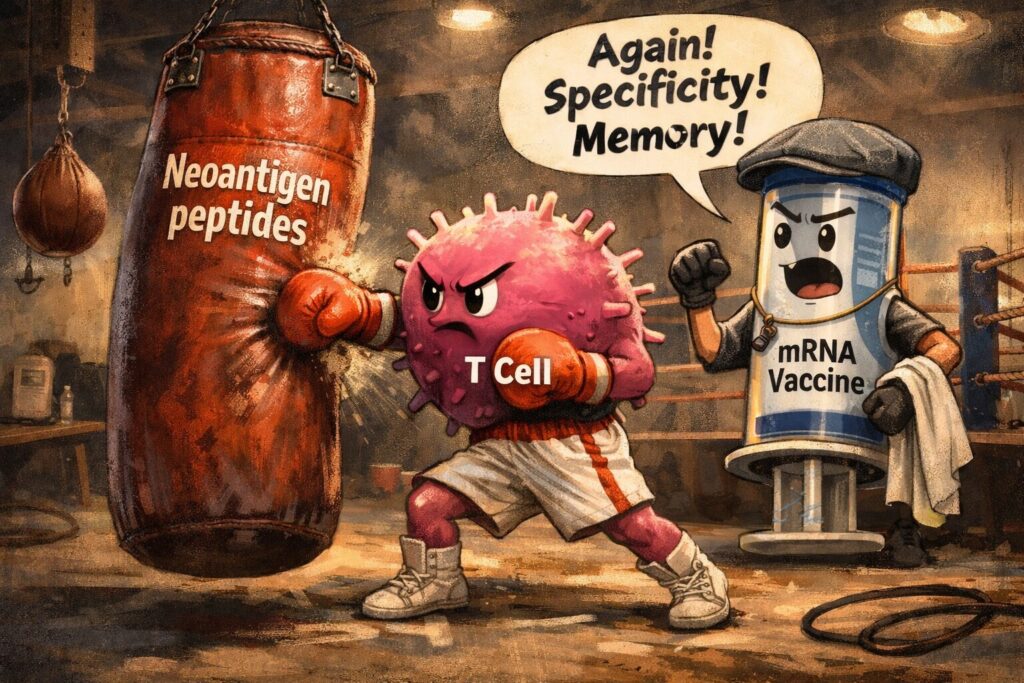
So what does a personalized mRNA cancer vaccine actually do? First, it delivers genetic instructions that let your own cells briefly produce tumor specific markers, usually neoantigens. Next, immune cells see those markers and ramp up a T cell response. In principle, that response can patrol for leftover cancer cells after surgery. Alternatively, it can help control microscopic disease before it returns.
Just as important is what it does not do. A personalized mRNA cancer vaccine is rarely a standalone cure. Instead, most strategies pair it with checkpoint inhibitors, because tumors can shut T cells down even when those T cells know what to attack. In that pairing, the vaccine supplies direction and numbers. At the same time, the checkpoint drug helps those T cells function inside hostile tumor tissue.
That framing matters, because it sets expectations. Put simply, a personalized mRNA cancer vaccine is a precision immune training program. Therefore, it succeeds only if targets are well chosen, the T cell response is strong, and the tumor cannot easily slip out of view.
Neoantigens: how cancer starts to look foreign
A personalized mRNA cancer vaccine works best when the immune system can see the tumor as an outsider. That is harder than it sounds. Cancer grows from your own cells. So the immune system often treats it like familiar tissue, or it learns to ignore it.
Neoantigens change that equation. They are small protein fragments created by tumor mutations. Because those mutations are new, the fragments can look foreign to T cells. In other words, the tumor accidentally manufactures its own “wanted posters.”
This is why personalization matters. Two people can have the same cancer type, yet their tumors can carry very different mutation sets. Even within one person, different tumor clones can carry different mutations. So a vaccine that targets generic cancer markers often hits a wall. It either looks too much like self, or the tumor finds a simple escape route.
Neoantigens offer a more direct path. If you can pick a set of mutations that the tumor cannot easily drop, you can train a T cell response that is both specific and hard to evade. That is the bet behind neoantigen prediction pipelines. Find the best targets. Encode them. Then push the immune system to treat residual cancer cells like invaders.
Of course, there is a catch. Most predicted neoantigens will not matter biologically. Some will not get presented well on MHC. Some will come from tumor subclones that disappear on their own. That is why section 4 will focus on the pipeline. The promise of neoantigens depends on selection, not just sequencing.
Building a personalized mRNA cancer vaccine: the pipeline
A personalized mRNA cancer vaccine is less like a single drug and more like a rapid manufacturing workflow. The biology matters. However, the logistics matter too, because the clock is always running.
Here is the basic sequence of steps.
- Collect tumor and normal samples
Doctors take a tumor sample, plus a reference sample from normal tissue or blood. The comparison tells you which mutations are truly tumor specific. - Sequence and interpret the tumor
The lab sequences DNA, and often RNA too. DNA shows the mutations. RNA shows which mutated genes are actually expressed. - Predict candidate neoantigens
Software ranks mutated fragments that are most likely to be presented on your MHC molecules (your HLA type). This step turns raw mutation lists into a shortlist of plausible immune targets. - Choose a set of targets to encode
This is where the craft lives. You want targets that are likely to be presented well, likely to be seen by T cells, and ideally shared across many tumor cells in that patient. - Write the mRNA “recipe”
The selected targets get encoded into an mRNA construct. The goal is transient expression that is strong enough to train the immune system, without sticking around. - Package the mRNA for delivery
The mRNA is formulated in a delivery system, often lipid nanoparticles or related carriers, so it can enter cells and get translated. - Quality control and release
Because every batch is custom, the process needs tight quality checks for identity, purity, and consistency. - Dose and boost on a schedule
Patients get multiple doses. In many trials, the vaccine is paired with checkpoint blockade so the activated T cells can function inside tumor tissue. To be successful predicted neoantigens must elicit a strong response, and the vaccine workflow must move fast enough to matter clinically.
Melanoma: the first strong signal for a personalized mRNA cancer vaccine
The clearest early test of a personalized mRNA cancer vaccine has come in melanoma, where doctors already use strong adjuvant immunotherapy after surgery and still see too many recurrences. That makes melanoma a good proving ground. If a vaccine can add meaningful protection here, it is doing real work, not just generating nice immune readouts.
The key study is KEYNOTE 942, a randomized phase 2b trial in patients with completely resected high risk cutaneous melanoma (stage IIIB to IV). It compared pembrolizumab alone to pembrolizumab plus Moderna’s individualized neoantigen therapy, mRNA 4157 (V940). Patients were assigned 2 to 1, and the total sample was 157.
What did it show. At the first major analysis, the combination arm had fewer recurrences. Recurrence free survival favored the vaccine combination with a hazard ratio of about 0.56, and the 18 month recurrence free survival rates were about 79% with the combination versus about 62% with pembrolizumab alone. Safety looked manageable, with most treatment related adverse events in the mild to moderate range.
The follow up story matters even more than the first snapshot. A later update, presented at ASCO 2024 and summarized by the companies, reported that the recurrence free survival and distant metastasis free survival advantages persisted with longer follow up (median about 35 months), with hazard ratios reported around 0.51 for recurrence or death and 0.38 for distant metastasis or death.
For me, this is the first time a personalized mRNA cancer vaccine has looked like it can shift a hard clinical endpoint in a randomized setting, not just light up immune assays. It is still an early stage trial. The sample size is modest. We need phase 3 confirmation. That next step is already underway in melanoma.
Pancreatic cancer: a personalized mRNA cancer vaccine on hard mode
If melanoma is a friendly proving ground, pancreatic cancer is the opposite. A personalized mRNA cancer vaccine has to work in a tumor that usually carries fewer mutations and builds a strongly immunosuppressive neighborhood around itself. That combination helps explain why checkpoint drugs have struggled in pancreatic cancer.
This is why it is worth paying attention when pancreatic data look even modestly convincing. In a small, early phase study in patients with resected pancreatic ductal adenocarcinoma, researchers gave a custom neoantigen mRNA vaccine called autogene cevumeran (BNT122) along with atezolizumab and then standard chemotherapy. The vaccine encoded up to 20 patient specific neoantigens selected from each tumor.
The headline result was not “tumors vanished.” It was something subtler and more useful. Eight of sixteen patients generated detectable vaccine induced neoantigen specific T cell responses, and those immune responses tracked with delayed recurrence in follow up.
What made the story stronger is durability. Follow up reports have described T cell activity that persisted for years in responders, alongside a stark split between responders and non responders in recurrence timing. That is still correlation, not proof. Still, in pancreatic cancer, durable and mutation specific T cells are a real signal.
I take two lessons from this. First, the core logic of a personalized mRNA cancer vaccine can survive contact with a “cold” tumor. Second, the field now has a clear standard for what comes next: larger, controlled trials that test whether the immune signal truly causes the clinical benefit, rather than merely accompanying it.
Why the personalized mRNA cancer vaccine is paired with checkpoint drugs
When we look across trials, we keep seeing the same pairing. A personalized mRNA cancer vaccine plus a checkpoint inhibitor. The reason is basic immunology. The vaccine can expand tumor specific T cells. It can also sharpen what those T cells recognize. However, tumors often shut T cells down once they arrive. They do it with suppressive signals, hostile metabolism, and checkpoint pathways like PD 1 and CTLA 4.
Checkpoint drugs help with that second problem. They reduce the braking signals that tumors exploit. So the T cells you generate with a personalized mRNA cancer vaccine have a better chance of staying active in the tumor.
Think of it as a two step system. The vaccine helps build a targeted army. The checkpoint drug helps that army keep fighting when the tumor pushes back. This is also why timing matters. Many studies test a personalized mRNA cancer vaccine after surgery, when disease burden is low. That setting gives the immune system a cleaner job. It can search for residual cells instead of trying to win a head on war against a large tumor mass.
There is a tradeoff. Combining immunotherapies can raise toxicity. Immune related side effects can be serious. So the field has to prove the added benefit is worth the added risk. That is the standard a personalized mRNA cancer vaccine will ultimately have to meet.
The bottlenecks and failure modes to watch
A personalized mRNA cancer vaccine can look elegant on paper and still fail for practical reasons. Biology can outmaneuver it, or the workflow can move too slowly to matter.
The first biological problem is tumor heterogeneity. Tumors are swarms of related clones. If the vaccine targets mutations carried by only some clones, the others can survive and drive relapse. Designs must prioritize early, clonal mutations over late, optional ones.
Next is immune escape. Tumors can stop showing the targets you trained T cells to recognize. They can lose an antigen, alter antigen processing, or downregulate MHC class I. Any of these moves can make a strong response suddenly ineffective.
A third bottleneck is T cell dysfunction inside tumors. Vaccination may expand T cells in blood, yet those cells can stall in the tumor microenvironment. Exhaustion, suppressive myeloid cells, and hostile metabolism can blunt killing. This is a key reason vaccines often pair with checkpoint blockade.
Then come the engineering constraints. Neoantigen prediction is imperfect. Many predicted targets will not be presented well, or will not matter clinically. Progress depends on better selection and validation.
Finally, there is the mundane constraint that decides everything: speed. A personalized mRNA cancer vaccine must go from biopsy to dosing quickly, with reliable quality control, or the tumor wins by default. Cost also matters, because access can become the limiting reagent.
So in new readouts, watch four things: how fast they vaccinated, how clonal the targets were, whether immune responses persisted and tracked outcomes, and whether combination toxicity stayed acceptable.
What would convince me the personalized mRNA cancer vaccine is real
I will believe a personalized mRNA cancer vaccine has arrived when it clears three bars at once: hard endpoints, generality, and clean causality.
First, I want phase 3 randomized results with clear clinical endpoints. Recurrence free survival is a start in the adjuvant setting. Overall survival is the finish line. I also want the benefit to persist with longer follow up, not fade as the curve matures.
Second, I want it to travel beyond melanoma. Melanoma is immunogenic and mutation rich. A personalized mRNA cancer vaccine that helps in colder tumors, across multiple sites, would signal a platform, not a one off.
Third, I want immune evidence that is more than vibes. I want to see:
- vaccine induced T cells that persist
- targets that map to clonal tumor mutations
- signs those T cells enter tumor tissue, not just blood
- a relationship between the immune response and who relapses that still holds after you control for the obvious clinical factors
Finally, the personalized mRNA cancer vaccine pipeline has to be fast, reliable, and scalable. If it cannot be delivered on time, it is not really a therapy. It is a concept.
The bet biology is making
A personalized mRNA cancer vaccine is built on a simple wager. Cancer is personal at the mutation level. If we can read those mutations fast, choose the right neoantigens, and manufacture a custom vaccine on demand, we can train an immune response that treats residual cancer as a foreign invader.
What makes this feel different from past cancer vaccine cycles is the convergence of tools. Sequencing is routine. mRNA is manufacturable at speed. And checkpoint blockade gives activated T cells a fighting chance inside tumors. Put together, the personalized mRNA cancer vaccine starts to look like a practical way to reduce relapse risk after surgery, when the disease is smallest and the immune system has room to work.
I am still cautious. Tumors evade. Prediction pipelines miss. Combination immunotherapy can carry real toxicity. And cost will shape access as much as biology does.
Still, the direction seems clear. If the phase 3 trials confirm the early signals, the personalized mRNA cancer vaccine will not feel like a niche trick. It will feel like a new therapeutic category: treating cancer with a tailored set of instructions, designed from the tumor itself, and delivered as immune training.
Your thoughts
I’m curious how you read the current personalized mRNA cancer vaccine story. Do you see this as the start of a repeatable platform, or another cycle that will stall once the early excitement meets tumor biology?
A couple specific questions I would love your take on:
-
Which bottleneck feels most decisive right now: neoantigen selection, speed from biopsy to dose, tumor escape, or T cell dysfunction in the tumor microenvironment?
-
What would convince you: phase 3 recurrence data, clear benefit beyond melanoma, or stronger evidence that vaccine induced T cells actually reach tumors and drive outcomes?
If you’ve worked with cancer vaccines, immunotherapy, genomics, or mRNA manufacturing, I would especially value your perspective. Leave a comment with your view, and if you have a favorite paper or talk that changed your mind, share it—I’ll add the best ones to the “Bleeding Edge Biology recommends” section.
Bleeding Edge Biology recommends
Peer reviewed anchors
- “Precision medicine meets cancer vaccines” — A tight overview of why personalized cancer vaccines are suddenly credible again (sequencing, prediction, delivery), plus the practical bottlenecks that still limit broad impact.
- Nat Rev Immunol review: key obstacles for neoantigen vaccines — A rigorous map of the hard parts: neoantigen prediction accuracy, tumor immune suppression, manufacturing timelines, and why “good immune responses” do not always translate into clinical benefit.
- NCI Cancer Currents: Neoantigen vaccines in kidney and pancreatic cancer — A plain language explainer of two small, surgery plus vaccine style studies, emphasizing what the trials can and cannot prove yet (and why “minimal residual disease” is a logical setting).
- MSKCC: Can mRNA vaccines fight pancreatic cancer? — A clinician friendly walkthrough of the PDAC approach, including what “personalized” means in practice and what immune readouts they tracked.
- Merck press release on V940 + KEYTRUDA (context + endpoints) — Useful for framing how sponsors communicate trial endpoints and effect sizes, and which outcomes they prioritize for the next phase of development.
Trials to watch
- NCT03897881 (V940 mRNA 4157 + pembrolizumab, adjuvant melanoma) — The “official record” for design specifics: eligibility, endpoints, arms, and how the personalized product is being tested in a controlled setting.
- NCT04161755 (autogene cevumeran in resected pancreatic cancer regimen) — The structured view of the PDAC strategy (surgery then immunotherapy vaccine chemo sequencing), which helps readers understand what combination logic is being evaluated.
Talks and videos
- TED: Meet the scientist couple driving an mRNA vaccine revolution — A compelling “platform story” from BioNTech’s founders that connects pandemic speed to the longer arc of mRNA as a programmable medicine concept.
- TED: Curiosity, Country Music, and Cancer Cures (Jim Allison) — A human, high signal narrative of how checkpoint immunotherapy became real, which sets the stage for why vaccines are now being paired with PD-1 pathway drugs.
- YouTube: Neoantigen Vaccines for Personalized Immunotherapy (webinar) — A more technical explainer that gets into how neoantigens are chosen and why prediction, HLA binding, and immunogenicity are the real gating steps.
Smart mainstream coverage
- Reuters (Mar 5, 2025): Roche BioNTech vaccine shows early promise in PDAC — A crisp summary of the PDAC “responders vs non responders” story, with timelines that make the stakes and uncertainty easy to grasp.
- WIRED: Karikó’s Nobel and the mRNA platform’s next phase — Great for readers who want the bigger arc: how mRNA went from fragile idea to validated platform, and why cancer is a natural next target.
- STAT: Personalized vaccine in kidney cancer (Feb 5, 2025) — A reality checked look at excitement vs sample size, with enough patient level detail to make “adjuvant vaccine after surgery” feel concrete.