
Introduction
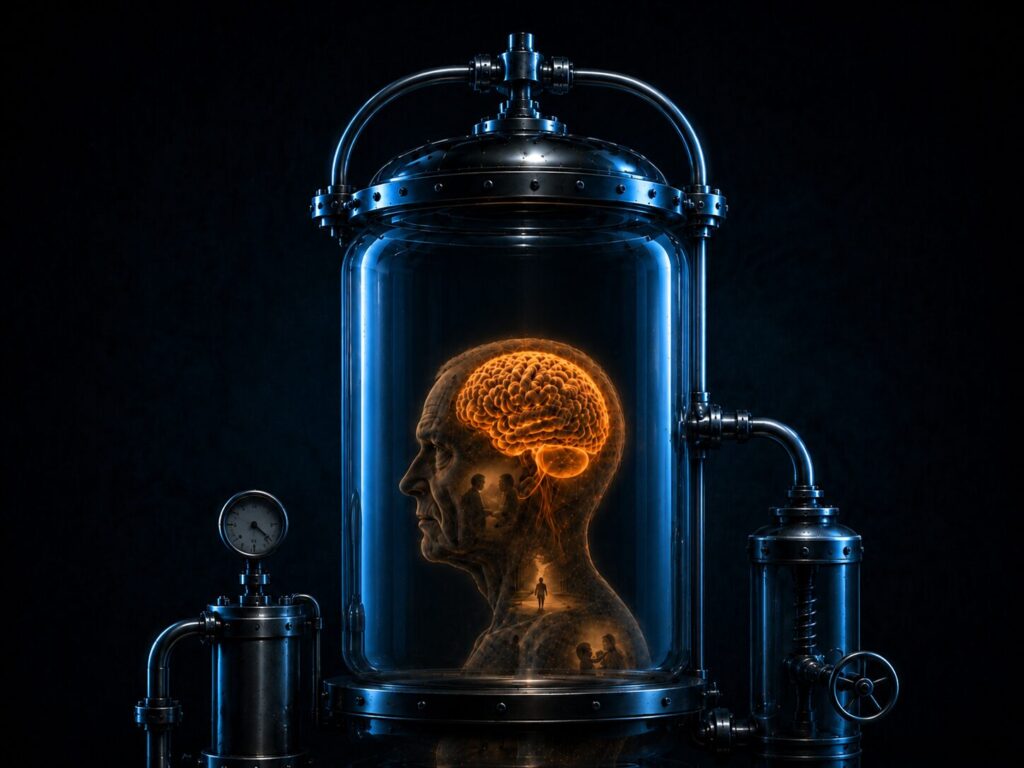
A human brain sits in a lab in New Haven, Connecticut. It came from a donor who died with Alzheimer’s disease. The donor is dead. Yet the brain is not. Not entirely. Right now, a machine pumps synthetic blood through its vascular network. This is brain perfusion drug testing, and it looks nothing like conventional medicine.
The cells keep metabolizing. The proteins stay active. Sensors record hundreds of data points as an experimental drug moves through the tissue. This is the BrainEx platform, the hardware behind Bexorg’s brain perfusion drug testing. Bexorg, a startup spun out of Yale University, built it. It has processed over 700 donated human brains in five years. Now it is scaling to 1,600 a year, with a robotic arm that analyzes 11,000 proteins per brain.
The news coverage of Bexorg split fast. On one side sat zombie-brain headlines. On the other sat soothing company press releases. In my view, neither framing does the story justice.
So I want to approach it differently. To me, the real story sits underneath the horror and the reassurance. It begins with a hard problem in drug development and a clever solution to it. And it raises a question the coverage keeps dodging: what actually dies when a person dies?
Earlier in this series, I covered organoid intelligence. Researchers grow those mini-brains from stem cells. Bexorg mirrors that work exactly. Organoid intelligence builds brains upward from cells. By contrast, Bexorg keeps existing brains going after death. Both raise the same question: what do we owe that tissue?
Organoid intelligence builds brains upward from cells. Bexorg keeps existing human brains going after death. Both raise the same question: what do we owe to that tissue?
Why CNS Drug Testing Has Been Failing, and Why Brain Perfusion Changes That
Consider why Bexorg exists at all. CNS drug testing has a poor record. A 2014 analysis of Alzheimer’s trials run between 2002 and 2012 put the failure rate at 99.6 percent, among the highest in medicine. Parkinson’s and ALS carry their own long records of clinical disappointment.
So we have spent billions of dollars and decades of research. Yet the number of disease-modifying treatments that have reached patients has been remarkably small.
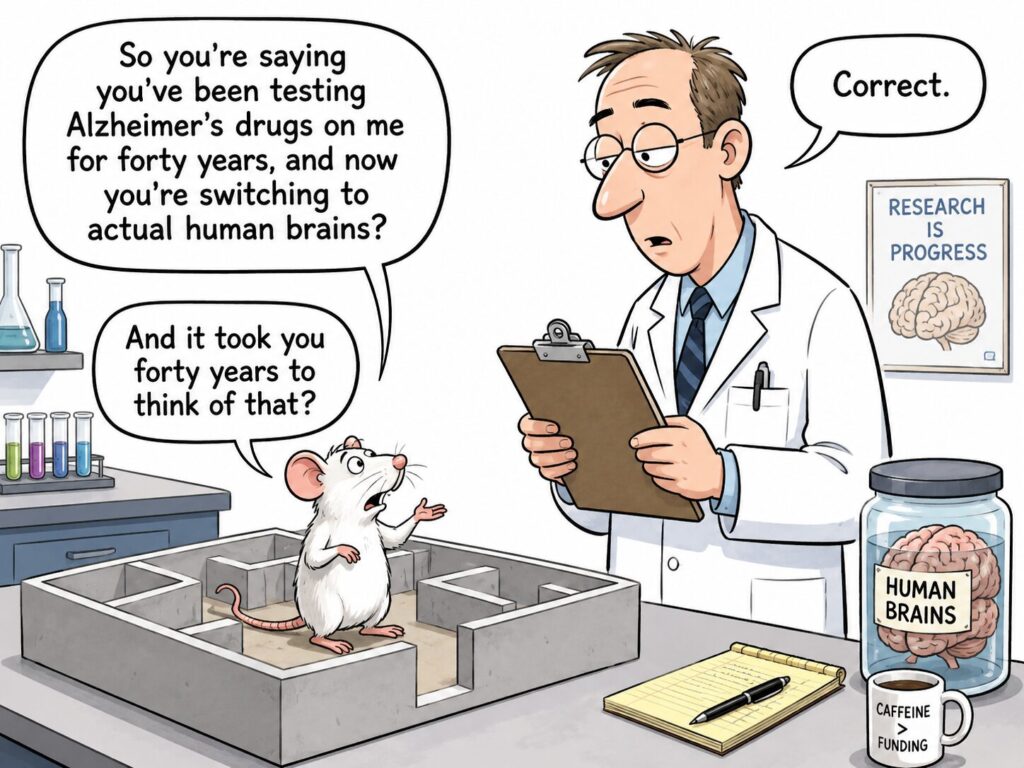
The core problem is simple: our testing models fall short. Mostly, researchers rely on mice for early drug development. However, mice do not naturally develop Alzheimer’s. So researchers engineer mouse strains that grow amyloid plaques. Then they test drugs on those animals.
The mice improve. The drugs reach human trials. After that, they fail. At every stage, year after year. Much of the biology does not transfer.
Cell cultures offer the other main option. Researchers grow neurons, add drug candidates, and measure the response. This runs faster and cheaper than animal models. Still, it sits even further from a real human brain.
Think about it. A few thousand cells in a dish share almost nothing with the organ in your skull. After all, that organ carries sixty or eighty years of biology, drug history, and genetics.
Where Brain Perfusion Drug Testing Comes In
Brain perfusion drug testing aims to close that gap. Founder and CEO Zvonimir Vrselja puts it plainly. Donated brains carry decades of exposure, drug histories, and unique genetics. Those factors shape how a brain responds to a new drug.
“You get cells that have been there for sixty to eighty years,” he told Science. No mouse and no dish can match that. Instead, a researcher can test a candidate in tissue that actually had Alzheimer’s.
Some working scientists back brain perfusion drug testing. Bruna Bellaver studies neurodegeneration at the University of Pittsburgh, and she has used the brain perfusion drug testing platform. In her words, it marks “a huge step up from mouse models.” Likewise, MIT’s Li-Huei Tsai called the brain bank remarkable.
To me, the stakes here are not abstract. The CNS failure rate has been a catastrophe for patients. Any platform that improves the odds deserves serious attention.
How the BrainEx Brain Perfusion Drug Testing Platform Works
The science traces back to 2019. That year, Vrselja and his mentor Nenad Sestan published a paper in Nature. Working in their Yale lab, they restored cellular function in pig brains hours after the animals died.
The brains were not conscious or alive in any organized sense. Even so, their cells stayed viable, and their molecular machinery kept running. The finding challenged a basic assumption, that once circulation stops for long enough, every cellular process in the brain slips past recovery within minutes.
Three years later, the same team went further. Their OrganEx system perfused the whole pig body, not just the brain. It circulated a chemical cocktail an hour after cardiac arrest. As a result, the team detected electrical activity in the hearts, and signs of cellular repair across several organs.
Vrselja described the microscope images. He could barely tell a healthy organ from a treated one.
Inside the BrainEx Machine
Bexorg applies the same principle to human brain perfusion drug testing. The BrainEx machine connects to the brain’s major arteries. Then it pumps a synthetic perfusate through the existing blood vessels. That fluid works like artificial blood. It carries oxygen, nutrients, and protective compounds.
The brain’s own vasculature spreads the fluid everywhere. The tissue turns metabolically active. It makes proteins. It responds to stimuli. Finally, it absorbs a drug, breaks it down, and produces measurable responses.
For now, a brain stays on the machine no longer than 24 hours. After that the lab slices it into hundreds of fragments for molecular analysis. Bexorg wants to stretch that window to two weeks, long enough to watch slower processes like plasticity respond to a drug.
Bexorg can biopsy the brain. So researchers learn how long a drug lingers in specific cell types. They also learn whether it hits its target. In addition, they spot early signs of side effects. Mouse models answer these questions poorly, and cell cultures answer only some of them.
The results already look concrete. For example, Biohaven has run about 130 of Bexorg’s brains for CNS drug candidates. In one case, a compound that had underperformed in mice hit its target in the human tissue at a dose twenty times lower than expected, saving close to a year of work. Data from across these brains went on to support the first-in-human trial of one of Biohaven’s CNS candidates, which began dosing in 2026.
One condition underlies all of it. Throughout the tissue, Bexorg suppresses electrical activity. It uses the anesthetic propofol. As a result, the brains never fire in any organized way.
The company frames it two ways. On the practical side, propofol suppression is a methodological necessity: spontaneous firing would burn energy and destroy the tissue. On the ethical side, it is a safeguard. With no organized electrical activity, the company argues, no consciousness can arise.
No consciousness can arise? What does that mean?
What Is Left When a Person Dies
Start with the case that unsettles people most. Imagine a whole human brain, perfused and running in a machine, with no sedation. It raises three questions, in descending order of what should trouble us. Is the donor still in there? Is the brain even conscious? And could the tissue hold any raw flicker of experience? Lets take them from the top.
Why the Person Is Gone: Death as a Loss of Integration
Begin with the donor. The person, the memories, the identity, the sense of being someone, is gone. A person is not identical to their cells. The body holds trillions of them, many with their own metabolism. Some survive stress for a while. A few even live briefly outside the body. None of that makes a person on its own.
What makes a person is integration. Blood circulates. The brainstem runs arousal. The cortex binds perception, memory, and action. The body signals back through hormones, immune signals, and gut signals, one continuous loop. Consciousness emerges from that organized system. So does the person. A person is a brain kept in continuous dialogue with a living body, moment to moment.
Death begins when that integration fails, and it can fail well before every cell does. A perfused brain sits past that line already. It may hold active cells, absorb a drug, even keep its vascular structure intact. All of that happens after the living system has already collapsed. It takes in nothing from a world and controls no body.
Here the argument needs to work harder, because a fair reader will ask about memory. Memory traces are physical: synaptic weight changes, receptor density, the shape of a dendritic spine. Early-phase LTP does not even need new protein synthesis, so a good deal of that structure probably survives, for a while, in tissue whose cells are still metabolizing. The raw material of memory is very likely still sitting in there.
But storage is not a person. A book on a shelf is not the person who wrote it. For a trace to become someone, something has to read it: relate it to a self, place it in a life, use the last moment to make sense of the next one. That reading was integration’s job, and it is exactly what collapsed. A person is that ongoing act of binding memory to a self across time, and storage alone cannot do that work. So even granting that the traces persist, the person built from them does not.
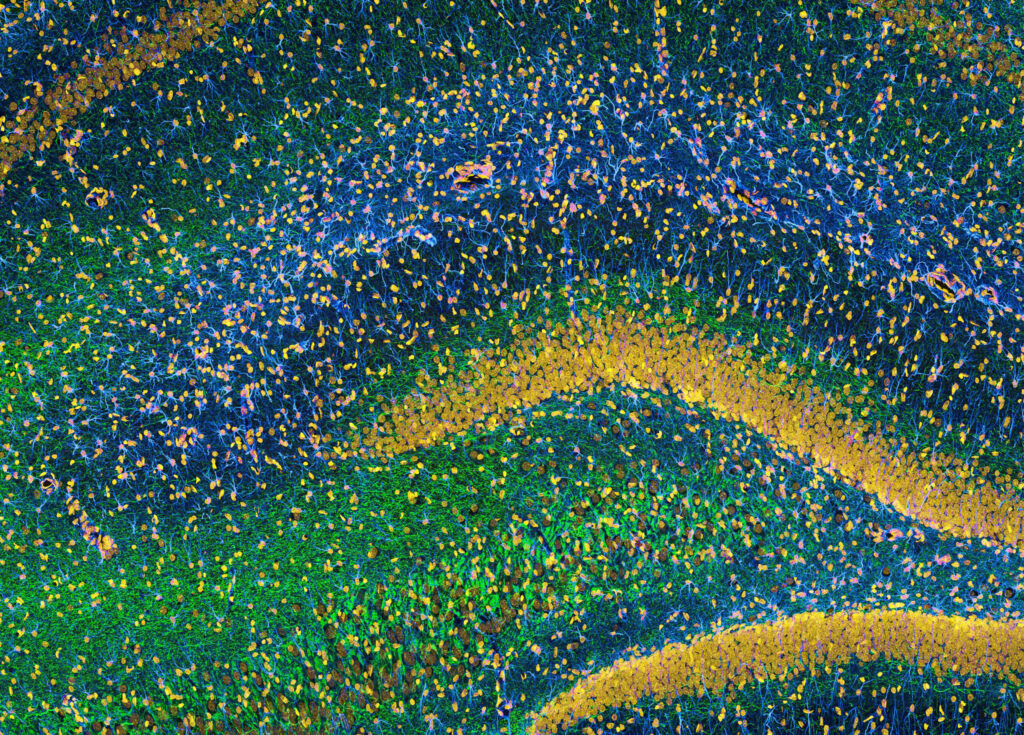
Hippocampal tissue, the brain’s memory-forming region, imaged by multiphoton microscopy. Credit: Tom Deerinck, NIH/NIGMS.
Why a Whole, Undrugged Brain Almost Certainly Isn’t Aware
The person is gone. But is the brain even conscious? Almost certainly not. Awareness is not simply what a brain does when neurons fire. Rather, it is a fragile, globally coordinated state. An intact brain sustains it through constant arousal from the brainstem, a precise neurochemical balance, thalamocortical loops in concert, and normally a stream of input from body and senses. A perfused brain has almost none of that.
The brain arrives already injured by oxygen loss. Moreover, the synthetic perfusate simply keeps cells alive. It does not rebuild a living brain’s signaling. No signals reach it from a body or the outside world. And when oxygen-starved tissue is reperfused, it fires chaotically. The activity is disorganized, hypersynchronous, seizure-like. In a living person, that kind of activity usually goes with a loss of consciousness. And left unchecked, it also destroys the tissue through excitotoxic stress.
So the likeliest picture is not a mind switching back on. Instead, it is damaged tissue sputtering with incoherent activity. It is poorly placed to support the coordinated state awareness needs. Brendan Parent, a bioethicist on Bexorg’s outside advisory board, agrees the brains arrive almost devoid of coordinated firing, since death came shortly before and age and disease cut the capacity further.
One caveat before moving on. No one has published what a fully unsuppressed, perfused human brain does over hours. Even the 2019 pig team blocked activity and ran EEG with anesthesia on standby. So this rests on reperfusion physiology, not direct measurement. The burden sits with anyone claiming such a brain would wake.
The One Question That Stays Open: Raw Experience
That leaves the smallest question, and the only one still open. Person-level awareness is off the table: the person is gone, so no one is there to be aware. But could active brain tissue hold any raw flicker of experience, some minimal sense of something-it-is-like, tied to no self and no world? We cannot rule it out, because no instrument detects experience of that kind in anything.
But I will not inflate it. There is no positive evidence for it. Moreover, the likely seizure-like activity is the kind least able to support experience. No instrument can fully rule it out, though. The company has an answer to this, which I come back to below.
Death Has Layers
Pull back from that narrow question. The larger lesson is that death has layers, and brain perfusion drug testing makes them visible. It is why brain slices, a much older technique, never caused the unease Bexorg does. A slice can fire. A neuron can respond. A circuit can even show plasticity. But those activities stay local, because a slice was never wired into a body.
Bexorg pushes the same principle to whole-organ scale, with more structure, more regions, and active responses well after death. Even so, the missing piece is still integration. A living cell after death does not make death unreal. Likewise, an active brain region does not mean awareness persists.
And the brain is not unique. All organs die unevenly. The heart can stop before every cell fails. Organs stay transplantable after the person is gone. And brain tissue can hold activity long after consciousness ends. So death is really a staged process, though the early order varies. Sometimes the heart stops first and consciousness follows. Sometimes an injury ends consciousness while the body runs on. From there the pattern steadies. Organs and systems fail before most of their cells do, and cells fail before their molecules. Bexorg’s brains sit in the awkward middle: after the person, before the cells. They hold tissue from a mind, but not the mind itself.
Bexorg’s Remedy: A Silenced Brain
Bexorg’s answer to that open question is to remove it. Propofol leaves its brains deliberately silenced, so they never fire in any organized way. Its planned drug-free tests use only slices, local fragments that cannot host whole-brain awareness. Brain perfusion drug testing runs precisely where “no consciousness” is most secure. As engineering, that is a reasonable choice. It protects the tissue and keeps the company clear of a gray zone.
The suppression that keeps the tissue safe also removes the only experience-like signal, so whatever Bexorg believes, the raw-experience question stays untested. That matters because the public messaging treats the question as closed. It folds the open question into the settled one and calls the result reassurance. The two deserve to stay apart.
That gap matters more as the window grows. A brain held stable for two weeks differs from one sputtering a few hours past death. My case against awareness leans partly on that early damage. As the tissue holds steady longer, the suppression carries more weight. And we know less about what it suppresses.
Brain Perfusion Drug Testing and the Donor Consent Question
Beyond consciousness, a separate ethical issue deserves attention: What did donors actually consent to?
Brain donation for research is well established. Thousands of people donate their brains posthumously. The governing frameworks matured. Typically, donors consent to “research.” In practice, that means academic study, publication, and the advancement of knowledge.
Bexorg, however, is something else. It is a commercial company, and its platform is a product. Pharmaceutical firms pay to test candidates on it.
So consider what follows. A brain donated “to science” now works as industrial testing infrastructure. Moreover, a robotic arm processes it at scale, aiming at 1,600 brains a year. That is not what the average donor pictured.
This is not necessarily wrong. Commercial use of donated tissue is not new. For decades, cell lines have driven pharmaceutical development, and their ethical frameworks are established, if still contested. Nor is Bexorg alone at the whole-organ level. Other firms already run commercial drug tests on donated human organs deemed unsuitable for transplant. They include Revalia Bio, another New Haven startup, and Ex Vivo Metrics. So the consent question is bigger than one company.
Even so, one open question remains. Bexorg says ordinary organ-donor registration is not enough, and that donors or their families give specific authorization for brain research. That covers the basic worry. The harder question is how plainly that authorization spells out commercial pharmaceutical testing, large-scale molecular analysis, data reuse, and the proprietary products that may follow.
The Knock-On for Organ Donation
Furthermore, organ donation could feel the downstream effects. Stuart Youngner, a bioethicist at Case Western Reserve University, flagged the risk. He responded to the 2019 pig paper with one worry. If brain death starts to look reversible, families may hesitate to donate a relative’s organs. Consequently, the pool of eligible donors could shrink.
To be fair, as we have explained, Bexorg’s platform does not reverse brain death. Still, it blurs the line between living and dead tissue in the public mind. And existing law was never built for that.
I am not calling the company reckless. Bexorg has engaged ethicists and designed its protocols carefully. However, I would like a richer public conversation. “we consulted ethicists, and there is no risk of consciousness” is not enough. The ethics here are complex, and they deserve that treatment.
The Limitations of Brain Perfusion Drug Testing That Bexorg Acknowledges
To its credit, Bexorg stays fairly honest about the limits. For instance, Li-Huei Tsai praised the brain bank, yet she added a caveat. BrainEx brains may not perfectly model living ones.
Consider a few gaps. The brain clears metabolic waste through its glymphatic system, a network that flushes byproducts along its blood vessels. Without a full body, drug clearance may run differently. So however carefully Bexorg designs its brain perfusion drug testing, it cannot fully replicate what happens in a living person.
A subtler worry concerns brain perfusion drug testing itself. Propofol is not inert. It suppresses neural activity, lowers the brain’s metabolic rate, and shifts blood flow. So every candidate is measured in a brain already flooded with an anesthetic. That could distort the very readouts brain perfusion drug testing sells, its numbers on uptake, how long a drug lingers, and how the tissue responds. After all, a silenced brain may handle a compound differently from an awake one. So whether propofol confounds the results is a question the unpublished data will have to answer.
Publication is another issue. Bexorg has shown human results in conference posters and partner disclosures, but no peer-reviewed full paper. The pig science sits in Nature. However, its human data has not passed peer review. Vrselja says a first paper is in preparation. Until it appears, their claims concerning the match between BrainEx brains and those of living people rest on a 2025 conference poster.
Where Brain Perfusion Drug Testing Fits in a Larger Story
Across this series, I have covered biology outside its usual context. Living therapeutics: bacteria engineered to sense and treat disease from within. Organoid intelligence: mini-brains grown from stem cells, learning to play Pong. Artificial metabolism: cell-free enzyme systems running chemistry with no living cell. These posts map a fast-moving frontier.
Now Bexorg adds an additional point, and the one most philosophically charged. Bacteria and enzymes raise no hard questions about consciousness. Mini-brains raise them faintly. After all, they are small, historyless, and never part of a person.
A donated human brain is different. It carried someone for decades, inside the very integrated system whose loss defines death. That is why it presses the consciousness and moral-status questions with a weight an organoid, grown from scratch, never could.
What Makes Bexorg Different
These differences shape both ethics and storytelling. Yes, brain perfusion drug testing is a useful tool.
It is more than a tool, though. It shows how far the line between living and dead tissue has shifted, now that a brain’s cells can keep working long after the person is gone. Our frameworks have not kept up. The consent donors give, the legal definition of death, and the oversight meant to govern this kind of work all lag behind. None of that makes brain perfusion drug testing wrong. It makes the case for clearer rules and more transparency.
I find this territory as fascinating as it is unsettling. On one hand, it is astonishing that a human brain can run outside a body at all. Twenty years ago, that looked like fiction. On the other hand, we are building capabilities faster than the ethics to manage them. Still, that is not a reason to stop. Rather, it is a reason to think, and to talk, more carefully.
We are building these capabilities faster than we are building the ethical infrastructure to manage them. That is not a reason to stop. It is a reason to think more carefully.
What the Brain Between Life and Death Is Telling Us
Bexorg’s platform is not science fiction. It runs as a commercial product in a New Haven lab. There, it processes hundreds of donated human brains for pharmaceutical clients. Moreover, the underlying science sits in Nature.
The company also holds a pharmaceutical partnership, an automated testing platform, and momentum. So if it delivers, it could well anchor CNS drug development within a decade.
The horror-story framing is wrong. Equally, the clean-breakthrough framing is wrong. The truth sits in between. This is a powerful, useful technology, built on a defensible principle: death is the loss of an integrated system, not the instant end of every cell. That principle explains who is no longer in the tissue. But it cannot close the question of whether anything is faintly experienced there, and the design keeps that untestable. Donor consent and commercialization stay unresolved too. So all of it deserves more than a press release.
None of this makes death less final. If anything, it makes life look more organized than we usually depict it. Life is a process held together across many levels at once, cells and organs and nerves and memory working as one system, until that system collapses and the person is gone.
What I’d Like to See Next
I want the transparency brain perfusion drug testing demands. Bexorg should publish its human brain data. Regulators should examine the consent framework for commercial donation directly. In other words, no one should assume the general rules already cover it.
Bexorg should put its EEG monitoring front and center, not bury it in a methods section. Finally, the scientific community should keep refining the integration question. Above all, it should recognize that suppression sidesteps the raw-experience question rather than answering it. That may be a sensible practical choice but it still leaves the question open.
The brain between life and death is not a metaphor. Instead, it is a physical object, in a machine, in a building. Right now, researchers use it to test a drug. So we must decide what that means, and what it obligates. And we must do that work now, not later.
Your Thoughts
Where do you land on where death actually ends? Does the commercial setting change the ethics of brain donation, or does it differ little from academic research? And if you came in against the idea of testing drugs on donated brains, did anything here shift your view?
It would be interesting to hear from readers in neuroscience, bioethics, or clinical drug development.
Leave a comment below.
Bleeding Edge Biology Recommends
For readers who want to go deeper on Bexorg, brain perfusion drug testing, and the philosophy of death this post covers.
Articles
Not Alive, But Not Dead: Disembodied Human Brains Used for Drug Testing
Science • May 2026
The primary news article that broke this story, based on a Science journalist’s visit to Bexorg’s New Haven lab. Covers brain perfusion drug testing, the Biohaven partnership, and the basic ethical arguments.
Restoration of Brain Circulation and Cellular Functions Hours Post-Mortem
Vrselja et al. • Nature • April 2019
The foundational Nature paper demonstrating cellular viability restoration in pig brains hours after death. The scientific foundation for Bexorg’s platform, including the EEG monitoring and standby anesthesia described in this post.
Stanford Encyclopedia of Philosophy
A rigorous philosophical treatment of what death actually means, including the integration and organism-death theories referenced in this post.
New Haven Startup Bexorg Uses Donated Brains to Reshape Drug Discovery
AdvanceCT • October 2025
A detailed profile of Bexorg from when the company came out of stealth mode. Covers the company’s history, Vrselja’s background, and the operational details of the BrainEx lab.
How Scientists Revived Dead Pigs’ Organs, and What the Feat Means for Transplants
Scientific American • 2022
An interview with Vrselja and David Andrijevic on the OrganEx whole-body pig perfusion work, addressing the ethical considerations directly.
Videos and Talks
Your Brain Hallucinates Your Conscious Reality
TED · Anil Seth · 2017
Seth argues that perception is a controlled hallucination, and that awareness depends on coordinated brain activity rather than raw firing. Direct background for the consciousness section.
TEDxCERN · John Searle
A philosopher of mind on what consciousness is and why it resists easy reduction. Useful for the question of what makes a person.
AWARE: Glimpses of Consciousness
Documentary · Sandig and Black · 2021
A documentary tracing where consciousness comes from and what happens as we die. Pairs with the idea that death arrives in layers.
Related Bleeding Edge Biology Posts
Living Therapeutics: A Remarkable New Way To Treat Disease
Bleeding Edge Biology • Synthetic Biology Series
The first post in the series examining biology operating outside its natural context.
Organoid Intelligence: The Remarkable New Rise of Living AI
Bleeding Edge Biology • Synthetic Biology Series
The direct mirror of the Bexorg platform: where BrainEx keeps existing human brains going, organoid intelligence builds new ones from scratch.

Thank you for this cutting edge report! You put forth the right questions, and clearly what is needed is more data from the company. One thing I would like to see more of is the technical aspects of which arteries and veins they connect, and what the perforate actually consists of. And of course, I’d like to see the EEG tracings, but it’s a safe bet they don’t correlate with a pattern of consciousness. How much propofol is being infused?
I was surprised to Here how high the failure rate is for drug studies of dementia. It’s clearly an important area of research and I hope the ambiguities of perception which you pointed out don’t slow down research in this area. In fact, I think your article will make a contribution to it!
Thank you! That’s generous, and you’ve zeroed in on some important details.
On the plumbing and the perfusate: the closest thing to a spec is the 2019 Nature pig paper, where the team connected to the major cerebral arteries and circulated a hemoglobin-based, acellular, non-coagulative solution. Essentially an oxygen carrier plus cytoprotective and anti-inflammatory agents, along with the activity blockers. For the human platform, the reporting describes four ports sutured into the brain and a synthetic blood substitute, but the exact arterial and venous connections and the full formulation haven’t been published. That’s really the crux: these are methods-section details, and there’s no peer-reviewed human methods section yet.
Same goes for the EEG tracings and the propofol dose. I couldn’t find either in the public record, and I agree that’s precisely what should be out there. Your bet that the tracings won’t show an organized pattern of consciousness is probably right. The one wrinkle though is that the propofol is doing the suppressing, so a flat trace is partly built in. Which is why the dose, and whether they’re titrating it to the EEG is important. That belongs in the open.
And yes, the ~99.6% failure rate in Alzheimer’s trials is both astonishing and dismaying. To be clear, I’m not advocating for slowing down the research. The enormity of the problem is what makes the platform worth taking seriously. My hope is the opposite, that more transparency makes the work more credible, not less. Thanks for reading so closely.